

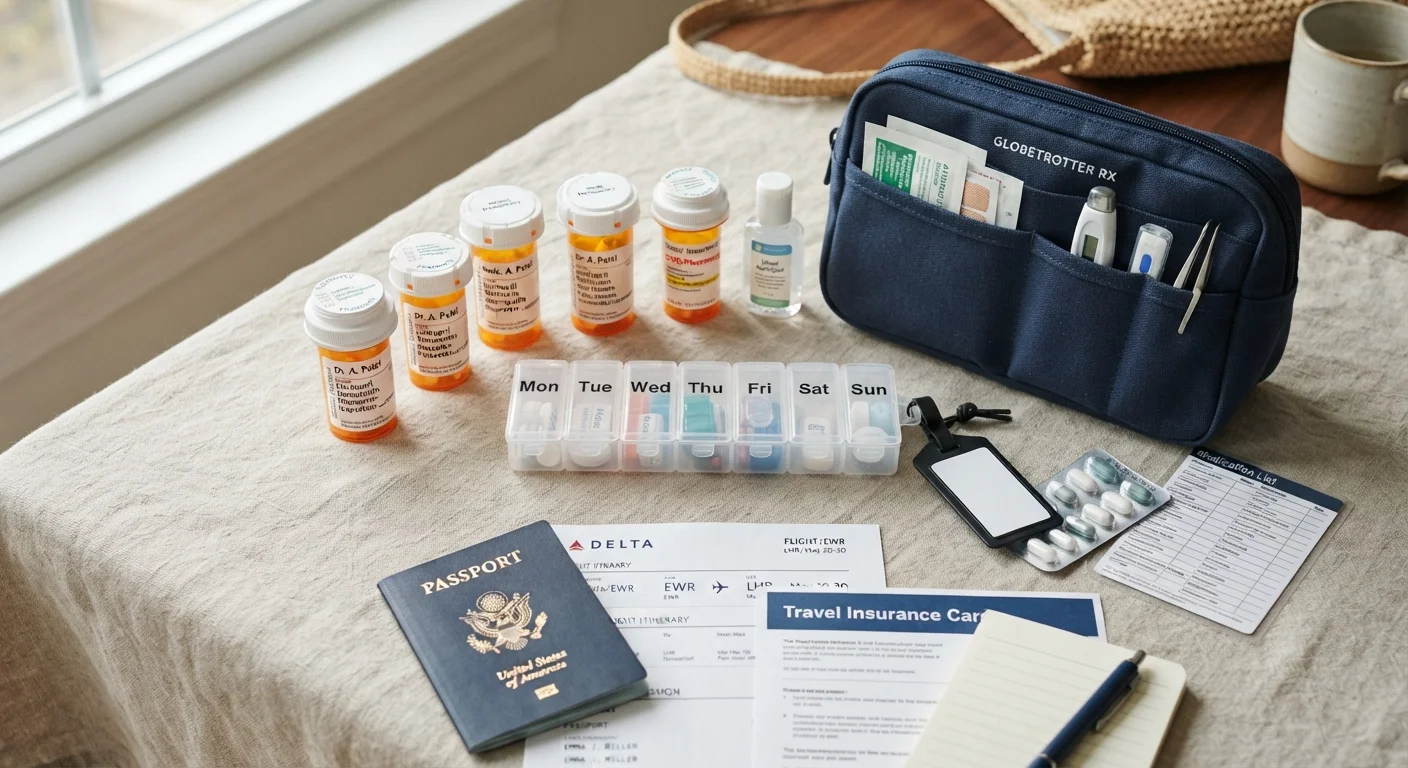
Key Takeaways
- Always carry original prescription labels and a letter from your prescribing doctor when travelling internationally.
- Some medications legal in the US are banned or tightly restricted in other countries — verify before you travel.
- Keep medications in carry-on luggage to avoid loss and maintain stable temperatures.
- Controlled substances require additional documentation and sometimes advance import permits.
- Official government embassy and customs websites are the most reliable source for country-specific rules.
Why Medication Travel Rules Matter
Travelling with medications — whether prescription or over-the-counter — involves more planning than most travellers realize. Customs agencies in many countries treat medications as regulated substances, and the rules governing what you can bring, in what quantities, and in what form vary significantly from one destination to the next.
Failing to comply with destination-country regulations can result in medications being confiscated at the border, delays, fines, or in rare but serious cases, legal trouble. Understanding the landscape before you leave is not just about convenience — it is about protecting your health and avoiding avoidable complications. This guide is for general informational purposes only; always verify current requirements with official government sources and consult your healthcare provider before travelling.
Before your trip, consider running through our comprehensive pre-departure checklist to make sure medications fit into your broader travel preparation.
Start Your Medication Research Early
Begin researching destination-country medication rules at least four to six weeks before departure. Some import permits for controlled substances take several weeks to process. Leaving this to the last minute is one of the most common and avoidable mistakes travellers make.
Documentation You Should Carry
Documentation is your first line of protection when travelling with any medication. At minimum, carry the following:
- Original prescription labels on each medication bottle, showing your name, the prescribing doctor's name, the pharmacy, and the drug name and dosage.
- A letter from your prescribing physician written in English, explaining your condition (in general terms), the medication name, dosage, and why it is medically necessary.
- Copies of the prescription itself, particularly for controlled or restricted substances.
If you take multiple medications, a consolidated medication list — including generic drug names — is useful both for customs officials and for any healthcare providers you might need to see abroad. Generic names matter because brand names differ by country.
For broader documentation guidance, see our travel document essentials reference guide.
Request that your physician write the letter on official letterhead and include both the brand name and generic name of each medication — customs officials in some countries only recognise one or the other.
Generic and brand names differ internationally, and a letter that specifies both reduces the chance of confusion or confiscation at the border.
Before any international trip, photograph your medication labels, prescriptions, and physician's letter and store them in a secure cloud folder — accessible even if your bag is lost.
Digital backups allow you to verify your medication details to a pharmacist or healthcare provider abroad even without physical documents.
Crossing International Borders with Medications
Every country sets its own rules for medication imports. What is a routine prescription drug in the United States may be classified as a controlled substance — or even prohibited entirely — in another country. This applies to some common medications including certain opioid pain relievers, some sleep aids, and specific ADHD treatments.
Before travelling internationally, check the embassy or consulate website of your destination country. The US Embassy and Consulates website also provides guidance on specific destinations. For trips involving multiple countries, verify each country's rules separately.
Verify Rules for Every Country on Your Itinerary
If your trip passes through multiple countries — including layovers — you must check the medication import rules for each one individually. A medication permitted in your final destination may still be confiscated during a transit stop in a country with stricter rules. Transit country regulations are often overlooked and can create serious complications mid-journey.
Quantity limits are another critical consideration. Many countries permit a personal-use supply of 30 to 90 days, but this varies. Carrying more than the permitted quantity — even accidentally — can flag your medications as intended for distribution rather than personal use.
If you are planning your first international trip and want a broader overview of entry requirements, our first international trip guide covers the full picture.
Packing and Storage Essentials
How you pack your medications is as important as what documentation you carry. Follow these practical guidelines:
- Always pack medications in your carry-on bag, never in checked luggage. Checked bags can be delayed, lost, or exposed to extreme temperatures in cargo holds.
- Keep medications in their original containers with intact pharmacy labels wherever possible. Pill organisers are convenient for daily use but are not recommended as the sole container for international travel.
- Temperature-sensitive medications — such as insulin or some biologics — require insulated cases and may need a doctor's note explaining storage requirements for security screeners.
- Carry a sufficient supply plus a buffer of at least several extra days' worth, in case of travel delays.
30–90 days
Typical personal-use supply limit at most borders
Quantity allowances for personal medication imports vary by country; exceeding them may trigger customs scrutiny regardless of documentation.
100+
Countries with specific controlled substance import rules
The International Narcotics Control Board notes that the majority of countries regulate cross-border movement of controlled substances under domestic law derived from international treaties.
If you are travelling by car across borders, note that domestic border crossings also have their own considerations. Our guide on crossing state or provincial borders by car outlines what travellers frequently miss.
Controlled Substances and Restricted Medications
Controlled substances — a category that includes opioids, benzodiazepines (anti-anxiety medications), certain stimulants used for ADHD, and some sleep medications — require extra care when travelling internationally. Many countries that permit these medications for personal use still require travellers to obtain an official import permit or carry a validated medical certificate before arrival.
The process for obtaining such documentation varies by country. Some require applications weeks in advance through a national health authority. Others accept a detailed physician's letter. A small number prohibit certain controlled substances outright, regardless of documentation.
The US Drug Enforcement Administration (DEA) and the destination country's health ministry or customs authority are the authoritative sources for this information. Do not rely solely on travel forums or secondhand accounts.
Do Not Assume Your Medication Is Permitted
Common US prescriptions — including certain ADHD stimulants, opioid pain relievers, and some anxiety medications — are prohibited or heavily restricted in countries across Asia, the Middle East, and elsewhere. A valid US prescription does not automatically grant entry rights in another country. Always verify with the destination country's embassy or customs authority well before your travel date.
Over-the-Counter Medications Abroad
Over-the-counter (OTC) medications present a less obvious but real complication. Some common US OTC products — including certain decongestants containing pseudoephedrine, some pain relievers, and specific cold medicines — are either prescription-only or banned in certain countries.
Additionally, if you plan to purchase OTC medications abroad as a backup, be aware that formulations, dosages, and drug names differ internationally. What is labelled as a familiar brand in another country may contain a different active ingredient or concentration than you expect.
It is generally advisable to bring a sufficient supply of any OTC medication you rely on regularly rather than assuming you can easily source it at your destination. This is especially true for niche or specialised products.
What to Do If Something Goes Wrong
Even well-prepared travellers encounter problems. Here is how to handle common scenarios:
- Medication is confiscated at customs
- Ask for a formal written receipt. Contact your travel insurance provider and the nearest US Embassy or Consulate for assistance. Your physician's documentation may help resolve disputes.
- Medication is lost or stolen
- Contact local police to file a report — many insurance claims and replacement prescriptions require it. Reach out to a local hospital or pharmacy with your documentation. Your travel insurance may cover emergency replacement costs.
- You run out of medication
- Contact your insurer and the nearest US Embassy. In some countries, a local physician can issue a short-term prescription; in others, the process is more complex. This is one reason a buffer supply and comprehensive travel insurance matter.
For a clear understanding of what your travel insurance may and may not cover in medical situations abroad, review our guide to what travel insurance actually covers.
This article is for general informational purposes only and does not constitute medical or legal advice. Regulations change frequently — always verify current requirements directly with the relevant government authorities and consult your healthcare provider before travelling with any medication.