

Key Takeaways
- The 3-1-1 liquid rule applies to carry-on bags only, not checked luggage.
- Laptops must be removed from bags at standard TSA lanes, but TSA PreCheck members are exempt.
- Wearing metal doesn't guarantee a pat-down — modern scanners detect density, not just metal.
- Arriving two hours early for domestic flights is a guideline, not a universal rule.
- TSA PreCheck and Global Entry are separate programs with different benefits and eligibility.
Why Airport Security Myths Persist
Airport security is one of those travel experiences nearly everyone has an opinion about — and nearly everyone has at least one habit built on a misunderstanding. Some myths circulate because rules have changed over time; others spread because a single traveler's experience gets treated as universal policy. The result is that millions of people slow themselves down, overpack toiletry bags, or dress anxiously for checkpoints based on information that simply isn't accurate.
Understanding what the Transportation Security Administration (TSA) actually requires — rather than what fellow travelers assume — is one of the most practical things you can do before a trip. Whether you fly once a year or once a month, separating fact from fiction at the checkpoint saves time, reduces stress, and helps the line move faster for everyone. If you're planning a longer journey, our travel destinations guide can help you think through the bigger picture of your trip.
Myth
You need to arrive at the airport at least two hours early for every domestic flight.
Fact
Two hours is a general guideline for busy airports and peak travel periods — not a fixed rule that applies to every situation.
The two-hour recommendation comes from airlines and travel advisors as a buffer for check-in, bag drop, and security. At smaller regional airports or during off-peak hours, 60–90 minutes may be entirely sufficient. Conversely, during major holidays or at large hub airports, even two hours can feel tight. The right lead time depends on your specific airport, airline, and whether you've checked in online and have no bags to check.
Myth
All liquids are banned from carry-on bags — it's safer to put toiletries in checked luggage.
Fact
Liquids up to 3.4 ounces (100 ml) per container are permitted in carry-on bags; the restriction applies to container size, not liquid type.
The TSA's 3-1-1 rule allows travelers to bring liquids, gels, aerosols, creams, and pastes in containers of 3.4 ounces or less, all fitting into one clear quart-sized bag, one bag per passenger. Checked luggage has no comparable container-size restriction for most liquids. Common confusion arises because people hear "liquid ban" and assume it's absolute. The rule is specifically about carry-on container size — your full-sized shampoo is fine in a checked bag.
Myth
You always have to remove your laptop from your bag at security.
Fact
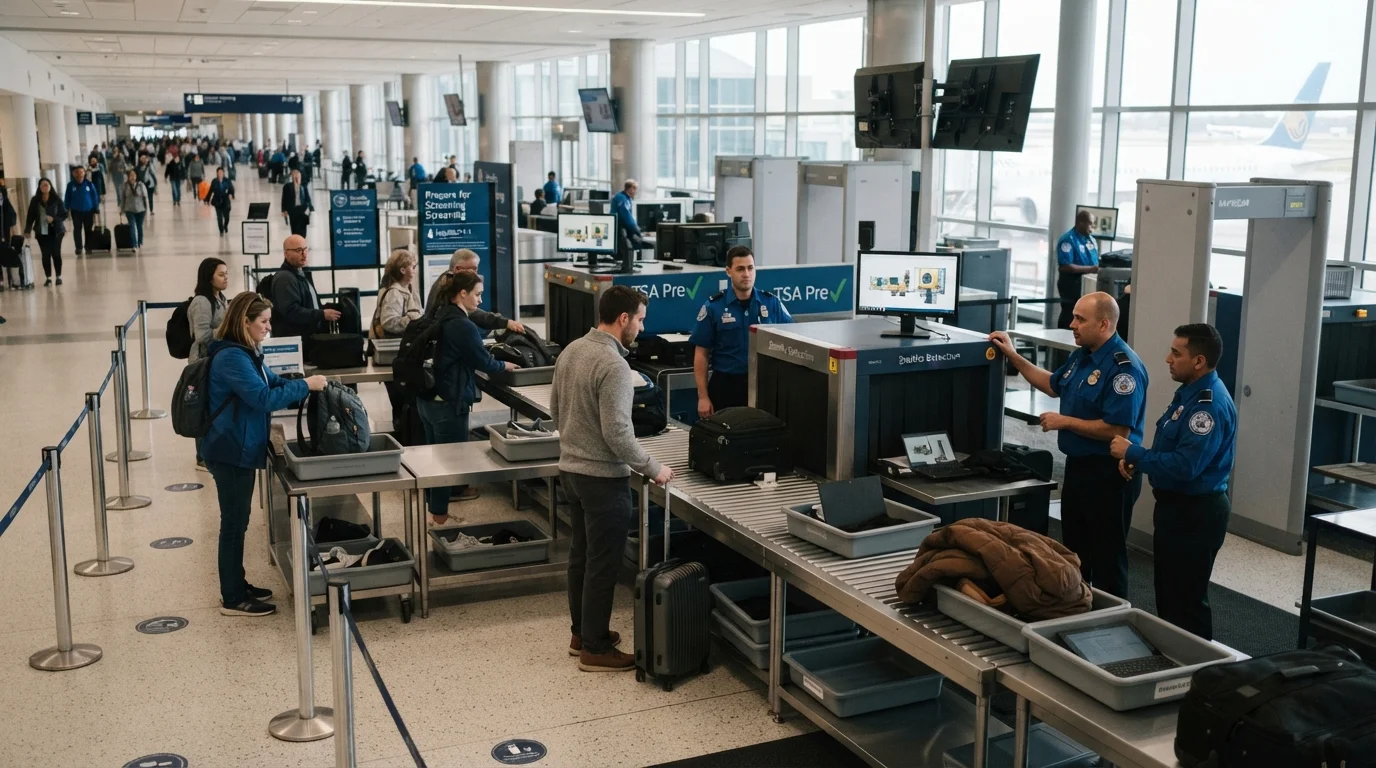
Laptop removal is required at standard TSA screening lanes, but TSA PreCheck members do not need to remove laptops or liquids.
At standard checkpoints, laptops must be placed in a separate bin so X-ray scanners can get a clear image. This rule exists because the density of a laptop can obscure other items in a bag. However, travelers enrolled in TSA PreCheck use dedicated lanes where laptops and compliant liquids can stay inside bags. Some airports also use advanced CT scanners at standard lanes that eliminate the need for laptop removal — but that's not universal, so it's safer to assume you'll need to remove yours unless you're in a PreCheck lane.
Myth
Wearing metal — a belt, jewelry, or underwire — will set off the alarm and trigger a pat-down.
Fact
Modern airport body scanners primarily detect anomalies by density and shape, not exclusively by metal content.
Older walk-through metal detectors did flag metal items, which is why travelers learned to remove belts and jewelry. Many U.S. airports now use millimeter-wave Advanced Imaging Technology (AIT) scanners, which generate a generic body outline and flag any area that differs from the expected image — regardless of material. Small earrings or a thin necklace are unlikely to cause an alarm. However, bulky items or anything that creates an unusual shape on the image may prompt a closer look. When in doubt, removing large metal accessories before the checkpoint is still a reasonable habit.
Myth
TSA PreCheck and Global Entry are basically the same program.
Fact
They are separate programs with different purposes: TSA PreCheck expedites domestic airport screening, while Global Entry speeds up U.S. customs re-entry for international travelers.
TSA PreCheck gives members access to dedicated security lanes where shoes, laptops, and liquids can stay in bags. Global Entry, administered by U.S. Customs and Border Protection, allows eligible travelers to use automated kiosks when returning to the U.S. from abroad — bypassing standard customs lines. Importantly, Global Entry membership includes TSA PreCheck benefits, but TSA PreCheck alone does not include Global Entry. Frequent international travelers often find Global Entry the more comprehensive option, while those who fly primarily domestically may find TSA PreCheck sufficient.
Myth
Packing snacks is risky — food almost always gets flagged or confiscated.
Fact
Most solid foods are permitted through security checkpoints in carry-on bags without issue.
The TSA allows most solid foods — sandwiches, fruit, nuts, crackers, and similar items — in carry-on bags. Liquids and gels in food form (such as soups, yogurt, jam, or peanut butter) are subject to the 3.4-ounce container rule. Items like a full jar of peanut butter or a container of hummus larger than 3.4 ounces will be flagged. Solid foods, including most baked goods and snacks, generally pass without complication. If you're unsure about a specific item, the TSA's "Can I Bring" search tool on their official website is a fast reference.
What These Facts Mean for Your Next Trip
The common thread across these myths is that secondhand advice — however well-intentioned — often lags behind current policy or misrepresents how screening technology actually works. The TSA publishes its rules publicly, and checking the official TSA website before any trip takes less time than repacking at the checkpoint.
Always Verify Rules Before You Travel
Security policies can change with little public notice, and rules may vary between airports or for specific flight routes (such as international departures). Before any trip, check the official TSA website or your airline's guidance for the most current requirements. Relying on what worked on your last trip — or what a fellow traveler told you — can lead to delays or confiscated items at the checkpoint.
A few practical habits make a reliable difference: pack your carry-on so that electronics and liquids are easy to pull out quickly, wear slip-on shoes if you prefer to avoid delays, and review what's in your bag before leaving home rather than at the bin. Travelers who use TSA PreCheck or similar trusted traveler programs should also confirm which lanes are available at their specific airport, since not all terminals or airlines participate equally.
Security anxiety is genuinely common — if the checkpoint experience stresses you out, you're far from alone. For broader context on managing travel-related worry, the facts about anxiety may offer some useful perspective. And if security myths sound familiar, our look at road trip myths covers a similar pattern of well-meaning misinformation that can derail your plans.
2.5M+
Passengers screened by TSA daily
The TSA reports screening more than 2.5 million travelers per day across U.S. airports, underscoring how consistent checkpoint knowledge benefits everyone in line.
15M+
Active TSA PreCheck members
As of recent TSA figures, more than 15 million travelers are enrolled in TSA PreCheck, reflecting widespread interest in faster, lower-friction screening.