

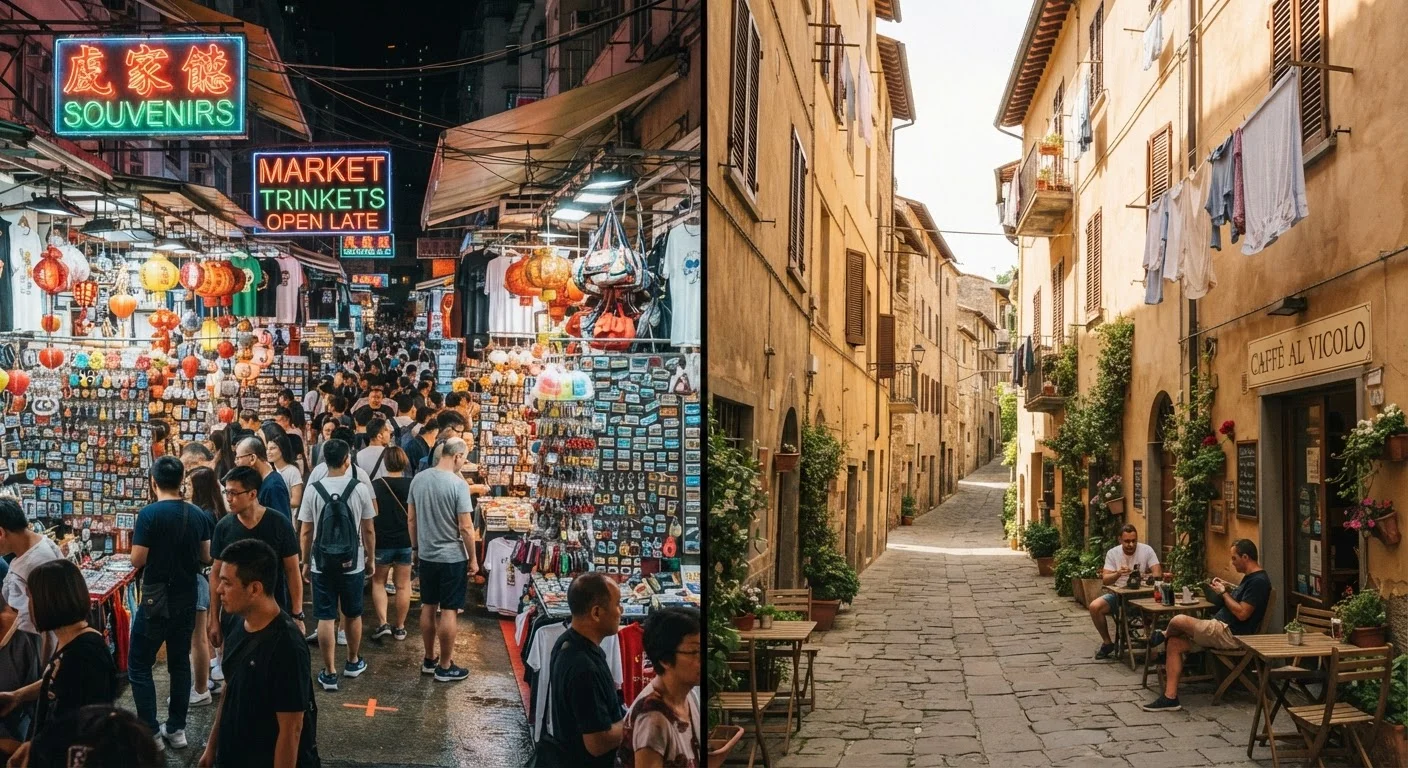
Key Takeaways
- Tourist traps prioritise extracting visitor spending over delivering genuine local experience.
- High foot traffic alone doesn't make a place a tourist trap — quality and value matter more.
- Hidden gems are often found by consulting locals, regional travel writers, or community forums.
- Pricing context is a useful signal: menus in multiple languages with no local prices often indicate a trap.
- Even iconic attractions can reward visitors who go at the right time or explore adjacent areas.
- Responsible research from varied, credible sources helps you set realistic expectations before you arrive.
Tourist Trap vs. Hidden Gem
A tourist trap is a destination or attraction that is heavily commercialised, often overpriced, and designed primarily to extract money from visitors rather than offer genuine cultural or scenic value. A hidden gem, by contrast, is a place — often lesser-known — that delivers meaningful, authentic experiences disproportionate to its fame or hype. The difference isn't always about popularity; some widely visited spots are genuinely worth it, and some obscure ones disappoint.
Travel researchers sometimes frame this distinction using the concept of 'perceived authenticity' — the degree to which visitors feel a place reflects its real local identity rather than a packaged version of it.
Why the Distinction Matters
Every traveller has felt it: the slow deflation of arriving somewhere hyped and finding little more than a queue, a gift shop, and an overpriced meal. Tourist traps aren't just disappointing — they consume time and budget that could have gone toward something genuinely rewarding. Understanding what separates them from authentic experiences helps you make better decisions before and during a trip.
This isn't about being contrarian or avoiding anything popular. It's about calibrating expectations and recognising when a place has been shaped primarily for commercial extraction rather than visitor experience. The good news: once you know the signals, they're not hard to spot.
Popularity Isn't the Problem
It's worth repeating: a place being well-known or heavily visited doesn't automatically make it a tourist trap. Many iconic sites — major national parks, historic landmarks, celebrated food markets — are popular precisely because they offer genuine value. The trap lies in commercialisation that degrades experience rather than in visitor numbers alone. Approach widely visited destinations with curiosity rather than preemptive cynicism, and use the signals in this article to assess what you actually find.
The Hallmarks of a Tourist Trap
Tourist traps share a recognisable cluster of characteristics. None of these signals is definitive on its own, but several appearing together should prompt a closer look:
- Prices disconnected from local norms. When a café directly beside a famous monument charges three times what an identical café charges two blocks away, the location — not the product — is being sold.
- Menus and signage in every language except the local one. This often indicates the business isn't competing for local customers at all.
- Souvenir saturation. Streets lined with identical merchandise — mass-produced items bearing the destination's name — suggest the area has been redesigned around visitor spending rather than local commerce.
- Restricted or rushed access. Paid attractions that funnel visitors through quickly, limit engagement, or offer little beyond a photo opportunity often prioritise throughput over experience.
- Overwhelmingly homogeneous reviews. If online reviews are nearly all five-star or all one-star with little nuance in between, treat them with scepticism. Genuine places attract varied, considered opinions.
Be especially alert to hidden travel costs that cluster around tourist-heavy zones — mandatory fees, compulsory tips, and currency conversion markups are common in these areas.
Walk Two Blocks in Any Direction
One of the simplest and most effective tactics for escaping a tourist-trap corridor is to walk away from the main attraction for two or three blocks, then look for where locals are actually eating, shopping, or spending time. Prices drop noticeably, quality often improves, and the character of the real neighbourhood becomes visible. This works in cities, coastal towns, and market districts alike.
What Makes a Hidden Gem
A hidden gem isn't necessarily remote or unknown. It's a place where the experience delivered exceeds what its reputation — or lack of one — would suggest. These spots share their own set of signals:
- A local clientele. If residents eat there, shop there, or spend leisure time there, that's a strong indicator of genuine quality and value.
- Context-appropriate pricing. Prices reflect local economic norms, not the premium that proximity to a landmark commands.
- Unscripted character. The place feels like it would exist whether or not tourists ever found it — because it would.
- Specific, detailed recommendations. When someone who lives in or near a destination names a particular street, stall, or viewpoint rather than a category, that specificity signals personal knowledge rather than generic advice.
Local food markets are among the most reliable indicators of a neighbourhood's authentic character. So are community noticeboards, neighbourhood parks, and independent bookshops — places where the infrastructure of daily local life is visible.
How to Research Smarter Before You Go
The most effective tool against tourist traps is preparation. A few research habits make a measurable difference:
- Layer your sources. Cross-reference major travel platforms with local journalism, regional travel writers, and community forums. Viral content and algorithm-driven recommendation engines tend to amplify already-crowded spots. Researching a destination responsibly means going beyond the first page of search results.
- Ask specific questions. In destination forums, ask where locals go for a particular experience rather than asking for general recommendations. Vague questions produce generic answers.
- Consider timing. Even genuinely over-commercialised sites can be worth visiting at low-traffic hours or seasons. Off-season trips often reveal a more honest version of a destination.
- Look adjacent. The neighbourhood beside a famous landmark is frequently less commercialised and more interesting. America's national parks, for example, reward visitors who venture past the iconic viewpoints into quieter trail systems.
Travelling by road gives you particular flexibility here — the ability to stop, double back, and explore without a fixed itinerary. Our road trips hub has practical guidance for building that kind of flexibility into a route.
~80%
Travellers who rely on online reviews for destination decisions
Research consistently shows the large majority of travellers consult online review platforms before visiting an attraction, underscoring how algorithm-amplified venues can dominate decision-making.
2–3×
Typical price premium in high-tourist zones
Travel consumer advocates have documented that food, beverage, and souvenir prices in heavily trafficked tourist corridors commonly run two to three times higher than equivalent goods a short distance away.
Top 3
Search results dominate most traveller research
Studies on search behaviour suggest most users engage primarily with the first three results returned, meaning less-commercialised, locally known spots are systematically underrepresented in typical travel research.