

Key Takeaways
- Smart speakers genuinely excel at hands-free timers, reminders, music playback, and basic home control.
- Privacy concerns around always-on microphones are legitimate and worth understanding before buying.
- Complex questions, nuanced tasks, and shopping decisions are areas where smart speakers frequently stumble.
- Placement matters — the rooms where you multitask most tend to benefit the most.
- Smart speakers work best as a complement to other habits and tools, not as a replacement for them.
Hands-free timers and reminders work reliably
Setting multiple timers simultaneously by voice is one of the most consistently useful features, especially during cooking. The response is fast and the accuracy is high for this type of simple, structured command.
Accessible for people with mobility limitations
Voice control removes the need for fine motor coordination to operate lights, thermostats, or media. This makes smart speakers a meaningful assistive tool for some users.
Smooth integration with compatible smart home devices
When paired with compatible bulbs, plugs, or locks, smart speakers enable simple routines that can be activated with a single phrase, reducing the need to manage multiple apps.
Music and audio playback is genuinely convenient
Streaming music, radio, podcasts, or audiobooks by voice is frictionless and works well across most major platforms. Volume adjustments and track skipping are equally responsive.
Quick answers to simple factual questions
Unit conversions, weather forecasts, dictionary definitions, and basic arithmetic are reliably fast and accurate — tasks where a voice response beats picking up a phone.
Always-on microphones raise privacy concerns
False wake-word activations can result in unintended audio being captured and stored by the platform. Users should review platform privacy settings and audio history regularly.
Accuracy drops sharply for complex questions
Smart speakers can deliver confident-sounding but incorrect answers to nuanced or fact-dependent questions. They should not be relied upon as authoritative sources for medical, legal, or financial information.
Voice shopping is poorly suited to considered purchases
Without a screen, comparing options, reading reviews, or confirming details before ordering is not possible. Impulsive or erroneous purchases are easier to make than to undo.
Requires consistent internet connectivity to function
Most smart speaker functions depend on cloud-based processing. A slow or interrupted connection can cause failed responses or delays, making the device unreliable during outages.
Multi-speaker households can face wake-word conflicts
Multiple devices in adjacent rooms may simultaneously respond to a single command, creating confusion or duplicate actions. Managing this requires deliberate setup and naming conventions.
Our Verdict
Smart speakers deliver genuine, daily-use value for people who want quick, hands-free help with routine tasks — timers, reminders, music, and basic smart home control. Their limitations around privacy, accuracy, and complex queries are real, and worth setting realistic expectations about before committing to one.
Best suited for households that want simple, voice-driven convenience and already use — or plan to explore — other smart home devices.
What Smart Speakers Actually Do
A smart speaker is a voice-activated device that connects to the internet and responds to spoken commands. It combines a microphone, speaker, and a cloud-based voice assistant — such as Amazon's Alexa, Google Assistant, or Apple's Siri — into one countertop unit. For a broader look at how these devices fit into a connected home, see our introduction to smart home devices.
At their core, smart speakers are designed for low-friction, conversational interaction. You speak a command, and the device processes it through remote servers before delivering a response — typically within seconds. That speed and simplicity is the central appeal, but it also means a reliable internet connection is a prerequisite, not a bonus.
How Voice Assistants Process Your Requests
When you speak a command, your smart speaker sends an audio clip to the manufacturer's cloud servers for interpretation — not just the wake word. This means an active internet connection is required for nearly all functions, and the platform's privacy policy governs how that audio data is handled. Most platforms allow users to review and delete their voice history through a companion app or website.
Where Smart Speakers Genuinely Help
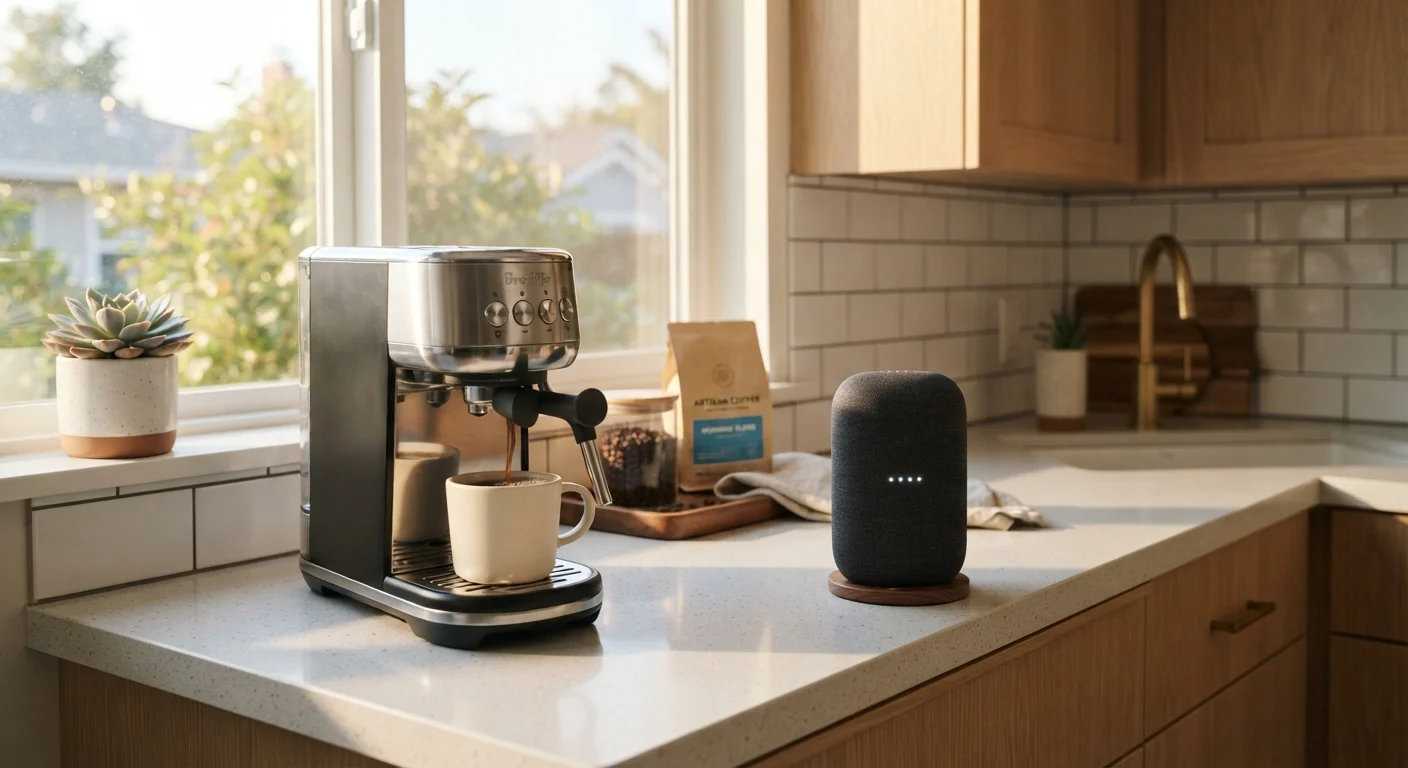
The strongest use cases are the mundane ones. Kitchens are the natural home for smart speakers: you can set multiple timers simultaneously, convert measurements, add items to a shopping list, or play a podcast — all without touching your phone or washing flour off your hands.
Hands-free timers and reminders work reliably
Setting multiple timers simultaneously by voice is one of the most consistently useful features, especially during cooking. The response is fast and the accuracy is high for this type of simple, structured command.
Accessible for people with mobility limitations
Voice control removes the need for fine motor coordination to operate lights, thermostats, or media. This makes smart speakers a meaningful assistive tool for some users.
Smooth integration with compatible smart home devices
When paired with compatible bulbs, plugs, or locks, smart speakers enable simple routines that can be activated with a single phrase, reducing the need to manage multiple apps.
Music and audio playback is genuinely convenient
Streaming music, radio, podcasts, or audiobooks by voice is frictionless and works well across most major platforms. Volume adjustments and track skipping are equally responsive.
Quick answers to simple factual questions
Unit conversions, weather forecasts, dictionary definitions, and basic arithmetic are reliably fast and accurate — tasks where a voice response beats picking up a phone.
Accessibility is another real strength. For people with limited mobility, low vision, or conditions that make typing or scrolling difficult, voice control can meaningfully reduce friction in daily life. Asking a device to turn off a light or play the news requires no fine motor coordination whatsoever.
Smart home control is similarly effective when it's set up well. Linking a speaker to compatible smart plugs, bulbs, or thermostats allows voice-driven routines — saying "good night" to dim lights and lock a compatible door, for example. If managing multiple devices is already on your radar, our guide on common mistakes with household devices is worth reading alongside this one.
Where They Fall Short
Smart speakers are less impressive when the task requires judgment, nuance, or accuracy. Complex factual questions — especially ones involving current events or medical information — can yield confident-sounding but incorrect answers. Treating a smart speaker as an authoritative research tool is a mistake.
Always-on microphones raise privacy concerns
False wake-word activations can result in unintended audio being captured and stored by the platform. Users should review platform privacy settings and audio history regularly.
Accuracy drops sharply for complex questions
Smart speakers can deliver confident-sounding but incorrect answers to nuanced or fact-dependent questions. They should not be relied upon as authoritative sources for medical, legal, or financial information.
Voice shopping is poorly suited to considered purchases
Without a screen, comparing options, reading reviews, or confirming details before ordering is not possible. Impulsive or erroneous purchases are easier to make than to undo.
Requires consistent internet connectivity to function
Most smart speaker functions depend on cloud-based processing. A slow or interrupted connection can cause failed responses or delays, making the device unreliable during outages.
Multi-speaker households can face wake-word conflicts
Multiple devices in adjacent rooms may simultaneously respond to a single command, creating confusion or duplicate actions. Managing this requires deliberate setup and naming conventions.
Voice commerce is another weak point. While you can ask a smart speaker to reorder household staples, the absence of a screen means you can't compare options, check reviews, or confirm what you're actually ordering. For more on making considered purchases rather than impulsive ones, our guide on making informed everyday purchases offers a useful counterweight.
The Privacy Question
Smart speakers listen for a "wake word" — a trigger phrase that activates recording and processing. In theory, the device only transmits audio after this word is detected. In practice, false activations do occur, and snippets of unintended conversation can be captured and reviewed by the platform's quality-assurance processes.
~19%
US adults who own a smart speaker
Pew Research Center surveys have consistently found that roughly one in five American adults report owning a smart speaker, with adoption concentrated in younger and higher-income households.
1,000+
False activations per device per year (estimated)
Academic research published by Northeastern University found that smart speakers can activate unintentionally hundreds of times annually, with some studies estimating over a thousand false triggers per device depending on household environment.
This is a legitimate concern, not paranoia. Understanding what data a device collects, where it's stored, and how to delete it is worthwhile before placing a microphone in a bedroom or home office. Most platforms offer voice history dashboards that let users review and delete recordings — a feature worth using regularly.
Those already thinking about the trade-offs of automating tasks in general may find useful parallels in our article on the trade-offs of automation — the themes of convenience versus oversight apply in both contexts.
Getting the Most Out of One (If You Have It)
Placement is the first decision worth thinking through. Rooms where your hands are consistently occupied — kitchens, workshops, home offices — tend to benefit the most. Bedrooms and common areas can also work well for alarms, reminders, and ambient music.
Matching the device to a small number of well-defined use cases, rather than expecting it to do everything, leads to more satisfaction. A smart speaker used for five consistent tasks will feel far more useful than one asked to do fifty things inconsistently.
If you're considering where to position a speaker in a room with limited surfaces or tricky corners, our piece on styling corners and awkward nooks has practical ideas for making the most of limited space.