

Key Takeaways
- Compound interest charges you interest on previously accumulated interest, not just the original balance.
- Credit cards typically compound interest daily, accelerating balance growth significantly.
- Making only minimum payments can result in paying far more than the original amount borrowed.
- The longer a high-interest debt goes unpaid, the harder it becomes to eliminate.
- Understanding compounding helps you prioritize which debts to pay down first.
Compound Interest on Debt
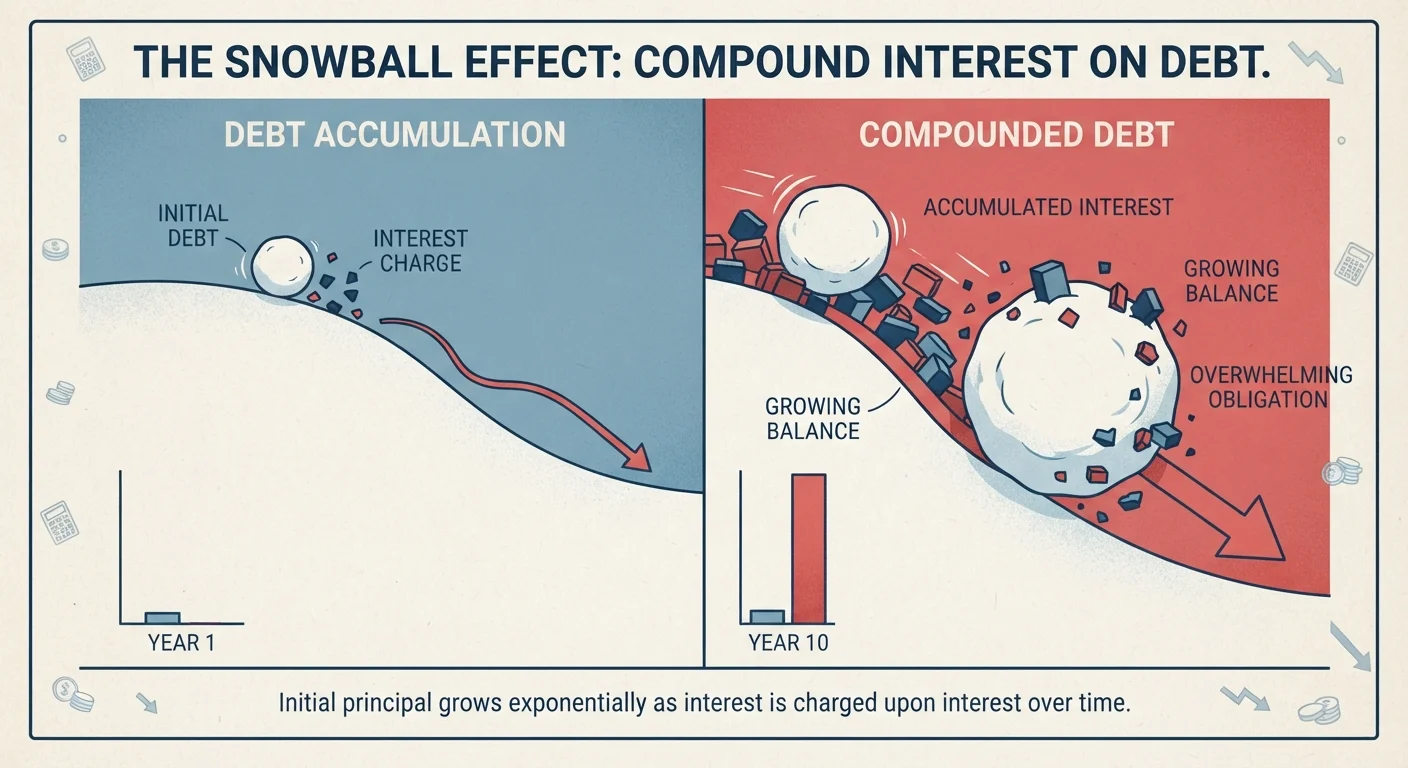
Compound interest means you're charged interest not just on the money you originally borrowed, but also on any interest that has already accumulated. On a debt like a credit card, this creates a cycle where your balance grows faster the longer it goes unpaid. It's the same mathematical force that grows savings over time — but working against you.
Compounding frequency matters: daily compounding (common with credit cards) produces a higher effective annual rate than monthly compounding at the same stated APR.
The Mechanics: How Interest Charges on Themselves
Most people understand that borrowing money costs something. But compound interest isn't simply a recurring fee — it's a fee that grows based on what you already owe, including previously charged fees. That distinction changes the math significantly.
Here's a simplified example: suppose you carry a $3,000 credit card balance at a 22% APR. In the first month, you might owe roughly $55 in interest. If that interest is added to your balance and you make no payment, next month's interest is calculated on $3,055. The month after that, it's calculated on an even larger figure. The balance compounds — it feeds on itself.
Understanding how debt accumulates from the beginning is essential context, because compounding behavior doesn't announce itself — it works quietly in the background of every statement you receive.
22%+
Average credit card APR in recent years
Federal Reserve data has shown average credit card interest rates exceeding 20% for new accounts, making compounding especially costly for cardholders carrying balances.
2–3×
Potential total repayment vs. original balance
Consumer Financial Protection Bureau guidance illustrates that minimum-only payments on high-rate revolving debt can result in repaying multiple times the original borrowed amount.
365×
Daily compounding cycles per year on most credit cards
Most U.S. credit card agreements apply a daily periodic rate to the outstanding balance, compounding charges every single day of the year.
Why Minimum Payments Are a Slow Trap
Credit card issuers set minimum payments low by design. A typical minimum might be 2% of your balance or $25 — whichever is greater. On a $5,000 balance at 20% APR, that minimum payment is almost entirely consumed by interest charges. The principal barely moves.
According to the Consumer Financial Protection Bureau, carrying revolving credit card debt and making only minimum payments can result in repaying several times the original balance over many years. The actual total depends on the rate, balance, and payment behavior — but the structural reality is consistent: low payments plus high compounding equals a very long, expensive journey to zero.
Pay More Than the Minimum Whenever Possible
Even a modest increase above the minimum payment — say, an extra $25 or $50 per month — can meaningfully cut both the time and total cost of repaying a high-interest balance. Because compounding works on the remaining principal, reducing that principal faster breaks the cycle earlier. If cash flow is tight, look for even small recurring expenses that could be redirected.
This is why two people can start with the same balance and end up in very different positions based solely on how much they pay each month. Compounding doesn't reward patience — it punishes it, on the debt side.
High-Rate Debt vs. Lower-Rate Debt: Not All Compounding Is Equal
Not all debt compounds the same way, and rate differences have an outsized impact over time. A credit card at 24% APR compounds far more aggressively than a federal student loan at 5% or a fixed-rate mortgage. This is why financial educators often emphasize prioritizing high-interest debt — every dollar of principal you eliminate on a 24% debt saves you significantly more over time than the same dollar applied to a 5% debt.
This principle underpins the debt avalanche method: listing your debts by interest rate, highest first, and directing extra payments to the top of the list while maintaining minimums on others. It's mathematically optimal for minimizing total interest paid — though the psychology of debt repayment sometimes argues for a different approach depending on the individual.
Balancing Debt Repayment Against Saving
A common question is whether to save money or pay down debt — and compound interest is central to that answer. If your savings account earns 4% annually but your credit card charges 22%, carrying that balance while saving is effectively a losing trade. The interest working against you outpaces the interest working for you.
That said, some savings — particularly an emergency fund — serve a purpose beyond pure math. Without one, a single unexpected expense may force you back into high-interest debt, erasing progress. Paying off debt while saving at the same time is genuinely possible with a structured approach, and it doesn't have to mean choosing one entirely over the other.
The key insight: compound interest is not neutral. On debt, it demands urgency. The small daily choices that shape your cash flow — explored in our piece on how small spending decisions compound over time — have a direct effect on how much room you have to accelerate debt repayment.
This article is for general informational and educational purposes only and does not constitute personalized financial or legal advice. Consult a qualified financial professional for guidance tailored to your situation.