

Key Takeaways
- Fake and incentivised reviews are common across major platforms, affecting purchasing decisions at scale.
- Language patterns, reviewer history, and timing clusters are among the most reliable signals of manipulation.
- Genuine reviews tend to include specific details, balanced criticism, and verifiable purchase context.
- Cross-referencing reviews across multiple independent platforms reduces your exposure to manufactured consensus.
- Platforms have detection systems, but no automated system catches everything — reader skepticism remains essential.
Why the Review Ecosystem Is Unreliable by Default
Online reviews have become the dominant way consumers evaluate unfamiliar products, services, restaurants, and destinations. Research consistently shows that a large majority of shoppers consult reviews before making a purchase. That attention creates an enormous commercial incentive to manipulate them.
The manipulation takes several forms: fully fabricated reviews written by paid services, incentivised reviews from customers offered refunds or free goods, review-gating that suppresses negative feedback, and coordinated downvoting of competitors. No platform has fully solved this. The result is an information environment where the aggregate star rating often reflects marketing activity as much as genuine customer experience.
Understanding this isn't cause for cynicism — it's cause for a more structured approach. Much like learning to recognise the signals that separate a legitimate message from a scam, spotting manufactured reviews is a learnable skill rather than a matter of luck.
The Signals That Suggest Authenticity
Genuine reviews share recognisable characteristics that distinguish them from manufactured content. The most reliable signal is specificity: authentic reviewers describe their actual experience in concrete, personal terms. They mention the context of use, what surprised them, what disappointed them, and how the product or service compared to their expectations.
Balanced tone is another strong indicator. Real customers rarely experience anything as uniformly perfect. A review that acknowledges a minor flaw — 'the instructions were unclear, but once assembled it worked well' — carries more credibility than unqualified praise. Verified purchase indicators, where platforms make them visible, add a further layer of accountability.
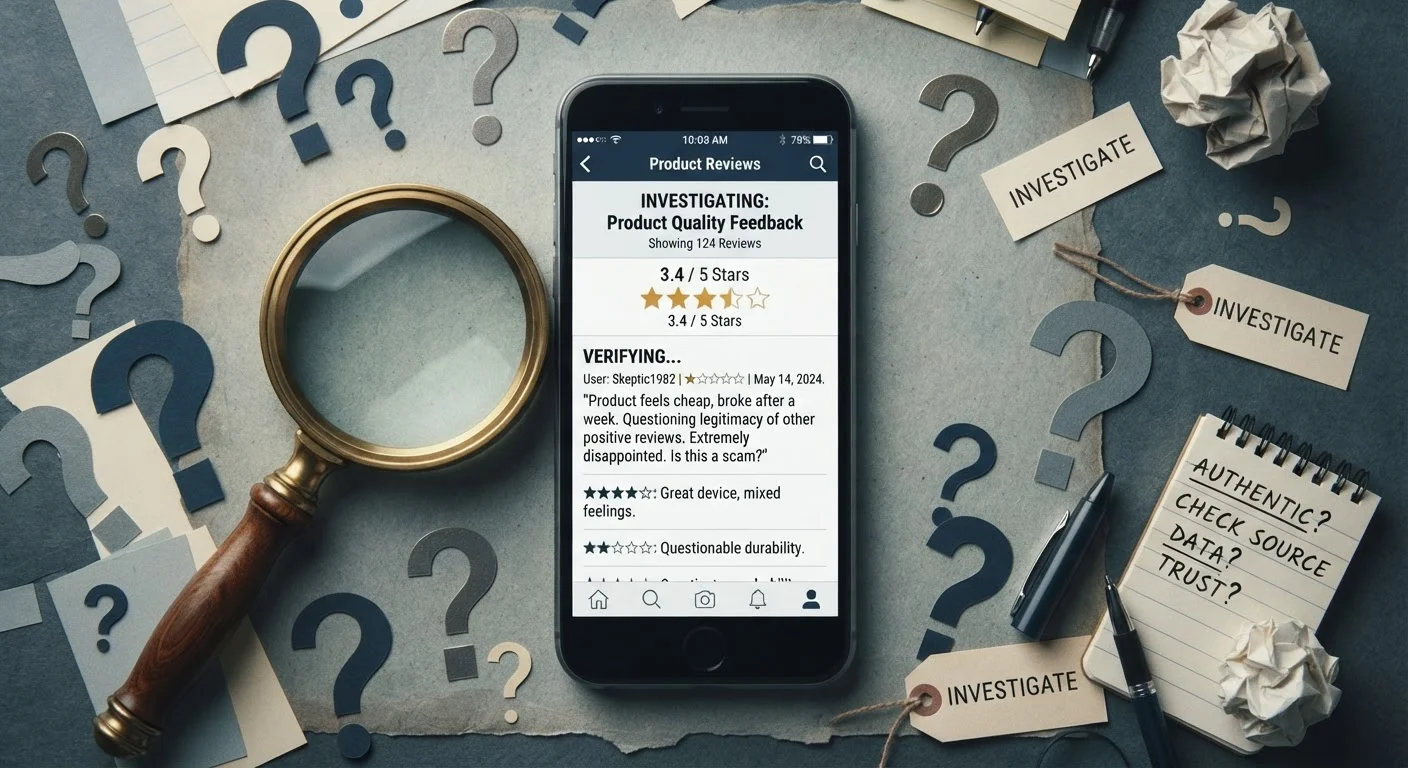
Read the one- and two-star reviews before the five-star ones.
Critical reviews are harder to fabricate at scale and are less likely to be suppressed or flooded out by campaigns. They also tend to surface specific, recurring complaints that reveal genuine product or service weaknesses.
Check the reviewer's profile and history before trusting their opinion.
Accounts with no purchase history visible, a single review, or a pattern of reviewing only one brand across many categories are consistent with manufactured or incentivised reviewing. Authentic reviewers typically have a mixed, varied history.
Look for specificity in the review text itself.
Genuine reviews usually mention particular use cases, dimensions, quirks, or comparisons to alternatives. Generic praise ('Great product! Highly recommend!') provides no verifiable information and is easy to generate in bulk.
Examine the timing distribution of reviews.
Organic review accumulation tends to be gradual and irregular. A sudden cluster of five-star reviews — especially around a product launch or after a negative press event — often signals a coordinated campaign rather than genuine customer response.
Cross-reference feedback across multiple independent platforms.
A business or product that scores well on one retailer's platform but poorly on independent forums, editorial review sites, or consumer advocacy communities is showing a credibility gap worth investigating further.
Be skeptical of review-gating patterns in business responses.
Some businesses selectively solicit reviews only from satisfied customers, a practice called review-gating that distorts the overall picture. Seeing only glowing responses with no negative experiences visible — despite a large volume — can be as telling as fake reviews themselves.
Reviewing the reviewer is equally important. A person who has left dozens of reviews across varied categories, with mixed ratings and recognisable personal voice, is behaving like a genuine consumer. An account with one review, no history, and generic phrasing is not.
Patterns That Suggest Manipulation
Manufactured consensus has its own recognisable fingerprints. Unusually high aggregate scores — particularly when the distribution shows almost no middle-ground ratings — are statistically improbable for most real-world products and services. Genuine populations of customers produce genuine spread.
Incentivised Reviews Are Not Always Illegal
Receiving a free product in exchange for a review is not inherently fraudulent — but the reviewer is typically required to disclose the arrangement under FTC guidelines in the US. Undisclosed incentivised reviews are the problem. A disclosed review can still be useful; weigh it accordingly rather than dismissing it outright.
Language analysis is also revealing. Fake review campaigns often produce text that is syntactically similar, emotionally superlative, and vague in detail. Phrases like 'life-changing,' 'absolutely perfect,' and 'exceeded all expectations' appear at higher rates in flagged reviews than in verified authentic ones, according to research into computational review detection.
Timing clusters are one of the clearest signals. Organic review accumulation follows the pace of real purchasing: gradual, irregular, and correlated with sales volume. A sudden spike — particularly around a seller's promotional activity — is inconsistent with natural customer behaviour.
Building a More Reliable Research Habit
No single signal is definitive. The most robust approach combines several: read across the rating distribution, check reviewer profiles, look for timing anomalies, and always seek corroboration from sources outside the platform where you intend to buy.
Independent editorial reviews, consumer advocacy organisations, specialist forums, and — where relevant — professional testing bodies offer perspectives that commercial platforms cannot easily fabricate. For travel decisions in particular, cross-referencing platform ratings with independent accounts is especially valuable; see how to evaluate travel information sources critically for a structured approach.
Being a more careful review reader also intersects with broader data awareness. The accounts you create, the platforms you use, and the information you volunteer in the process all carry implications worth understanding — the same mindset that improves review literacy applies to reviewing your own privacy settings on platforms you use regularly.
“The most dangerous kind of fake review isn't the obvious five-star spam — it's the carefully written, plausible-sounding review that mimics the language of genuine experience while conveying none of the reality.”
— Saoud Khalifah, Founder of Fakespot, a platform specialising in review authenticity analysis
Approaching reviews as data to be evaluated rather than verdicts to be accepted is the fundamental shift. A product with a 4.1 average built from 600 varied, specific, historically consistent reviews is telling you something more reliable than a 4.9 built from 80 reviews posted in a single week. Train yourself to see behind the number.
Similarly, when evaluating loyalty programmes and retail schemes, the same critical lens — what is the business incentivising, and why — helps you distinguish genuine value from marketing architecture designed to look like it.