

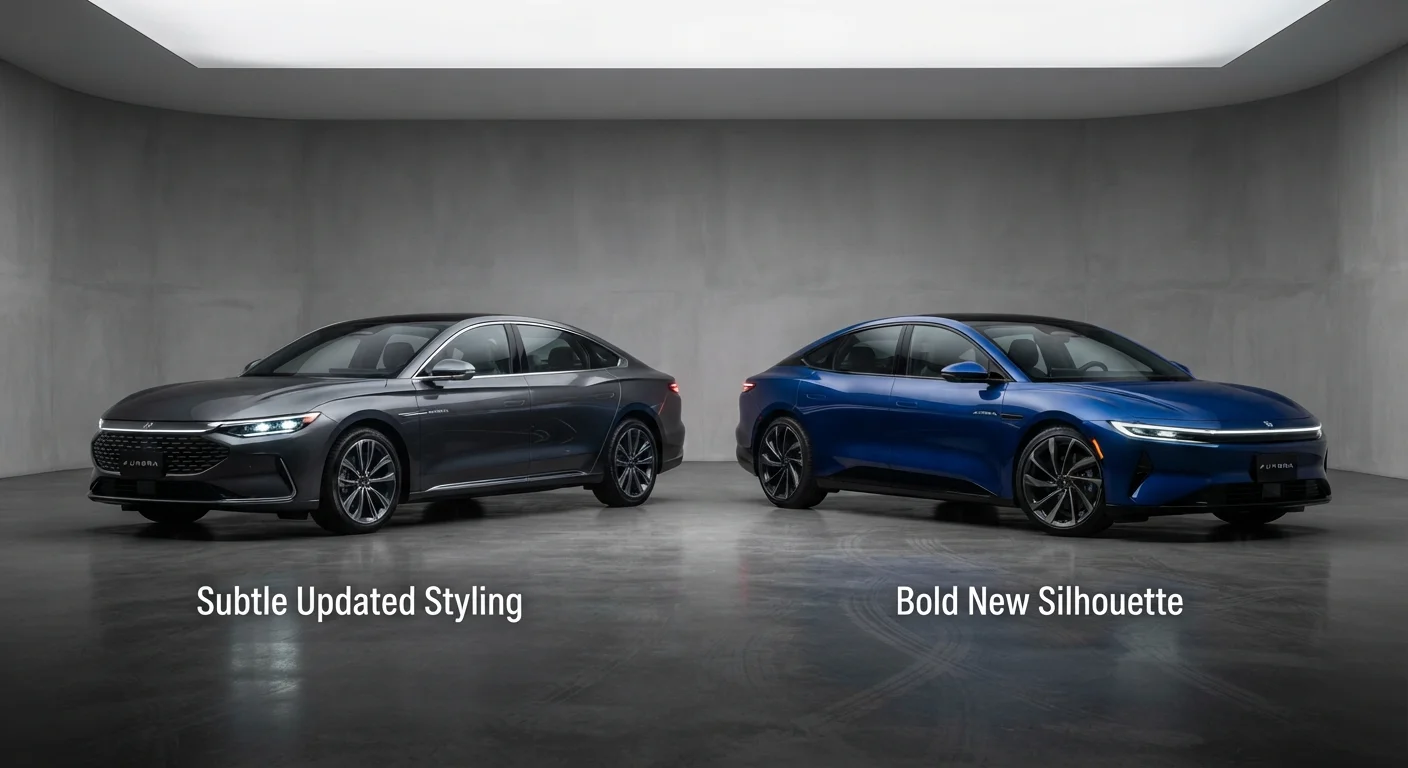
Key Takeaways
- A mid-cycle refresh typically updates styling, features, and trim options without changing the underlying platform.
- A full redesign rebuilds a vehicle from the ground up, often introducing a new platform, powertrain, and safety architecture.
- Automakers typically conduct a refresh around the midpoint of a model's 5–8 year generation cycle.
- Full redesigns are far more expensive and time-intensive, often taking four to six years of development.
- Knowing the difference helps consumers and auto enthusiasts interpret car news with greater accuracy.
Option A
Mid-Cycle Refresh
The targeted, cost-efficient update that keeps a model competitive mid-generation.
Best for: Buyers and followers who want to understand incremental updates without expecting a fundamentally different vehicle.
Option B
Full Redesign
The ground-up overhaul that resets a model's platform, engineering, and identity.
Best for: Readers tracking major generational leaps in technology, safety, and driving dynamics.
If you're following auto news and want to gauge how significant an update really is
Mid-Cycle Refresh awareness
Recognizing refresh signals — updated fascias, revised infotainment, new trim names — helps you avoid overstating a routine update as a brand-new model.
If you're tracking a model for major technology or safety improvements
Full Redesign
Only a full redesign brings platform-level changes like new suspension architecture, updated crash structures, and next-generation powertrain options.
If you're curious why the same model looks slightly different year to year
Mid-Cycle Refresh
Subtle grille tweaks, revised headlights, and updated interior trims between full generations are hallmarks of a mid-cycle update.
What Is a Mid-Cycle Refresh?
A mid-cycle refresh — also called a facelift or mid-cycle enhancement — is a planned update automakers apply roughly midway through a model's production generation. Rather than replacing the vehicle's core engineering, a refresh touches visible and feature-level elements to keep the model fresh and competitive.
Typical refresh changes include revised front and rear fascias, updated headlight and taillight designs, a restyled interior dashboard or trim materials, new infotainment software, and the addition or removal of trim levels. Mechanical changes, if any, are usually limited to minor powertrain calibration adjustments or the addition of a new engine variant that was already developed for the existing platform.
From a production standpoint, a refresh is significantly less disruptive than a redesign. Assembly lines require relatively minimal retooling, development costs are a fraction of a full program, and the timeline from decision to showroom can be as short as two to three years. For automakers, this makes refreshes an efficient tool for responding to competitive pressure or shifting consumer preferences without committing to a full product cycle. To understand what drives those decisions at a strategic level, see how automakers decide when to redesign a car.
| Criterion | Mid-Cycle Refresh | Full Redesign |
|---|---|---|
| Platform | Unchanged from launch | Entirely new or heavily revised |
| Exterior changes | Fascia, lights, trim details | New body, proportions, silhouette |
| Interior | Updated dash, trim, infotainment | Clean-sheet design |
| Powertrain | Mostly carried over; minor tuning | New or significantly redesigned |
| Safety structure | Unchanged crash architecture | New body structure; re-tested |
| Development time | 2–3 years | 4–6 years |
| Development cost | Significantly lower | Can reach billions of dollars |
| Frequency in cycle | Once per generation | Every 5–8 years, typically |
What Is a Full Redesign?
A full redesign — sometimes called a next-generation model or all-new vehicle — is exactly what it sounds like: a ground-up rebuild of the vehicle. Engineers start with the platform, the fundamental underpinning that defines wheelbase, suspension geometry, and structural rigidity, and redesign it to meet updated safety standards, weight targets, and technology requirements.
Beyond the platform, a full redesign typically introduces new body structures that improve crash performance, updated or entirely new powertrain families, a clean-sheet interior, and revised exterior proportions that may depart substantially from the outgoing model's appearance. These programs take four to six years from initial planning to production launch and carry development costs that can reach into the billions of dollars for high-volume models.
A redesign also resets a vehicle's generational clock. Once an all-new model launches, consumers and analysts begin anticipating the next mid-cycle refresh — typically scheduled three to four years later — followed eventually by another full redesign. This rhythm is sometimes called the product cycle, and understanding it is essential context for reading automotive news critically. For a broader look at following these announcements, what to look for when following new car news offers a useful framework.
5–8 years
Typical full model generation length
Most mainstream automakers plan full redesigns on a five-to-eight-year cadence, with a refresh occurring around the midpoint.
~Year 3–4
When a mid-cycle refresh typically arrives
Industry convention places the refresh at roughly the midpoint of a generation to sustain showroom interest before the next full redesign.
How to Tell Them Apart When You Read Car News
Automakers don't always make the distinction obvious in their press materials. A refresh may be presented with considerable fanfare, using phrases like "all-new interior" or "redesigned front end" that can be misleading if the platform and core engineering remain unchanged.
Several clues help distinguish the two. First, look at the model year designation alongside the generation label. If an automaker refers to a vehicle as a second-generation model, that confirms a full redesign. If the generation stays the same but the model year advances, a refresh is likely. Second, check whether the platform is described as new. Terms like "new modular architecture" or "next-generation chassis" signal a redesign. Third, examine whether crash test ratings were re-evaluated from scratch — a redesign almost always triggers new safety testing, while a refresh typically does not. Finally, pay attention to powertrain family language. A redesigned model often introduces an entirely new engine code, while a refreshed one retains the same unit with possible output revisions.
Auto journalists and industry analysts also track spy shots of prototype vehicles — heavily camouflaged test mules photographed during development. A prototype showing a radically different silhouette typically signals a full redesign, while one that appears to share the basic body structure with the current model points toward a refresh. Reading a car reveal explores how to interpret those early previews with a discerning eye.
Why the Distinction Matters for Consumers
Consumers shopping for a vehicle benefit from knowing where a model sits in its product cycle. A model that just received a full redesign is likely at the start of a fresh platform with updated safety ratings. A model nearing the end of its generation — or just past a refresh — may be approaching its next full redesign, which can influence near-term resale value and technology currency. Neither timing is inherently better, but awareness helps buyers make more informed decisions. For a deeper look at the steps between announcement and sale, see the journey a new car takes before it goes on sale.