

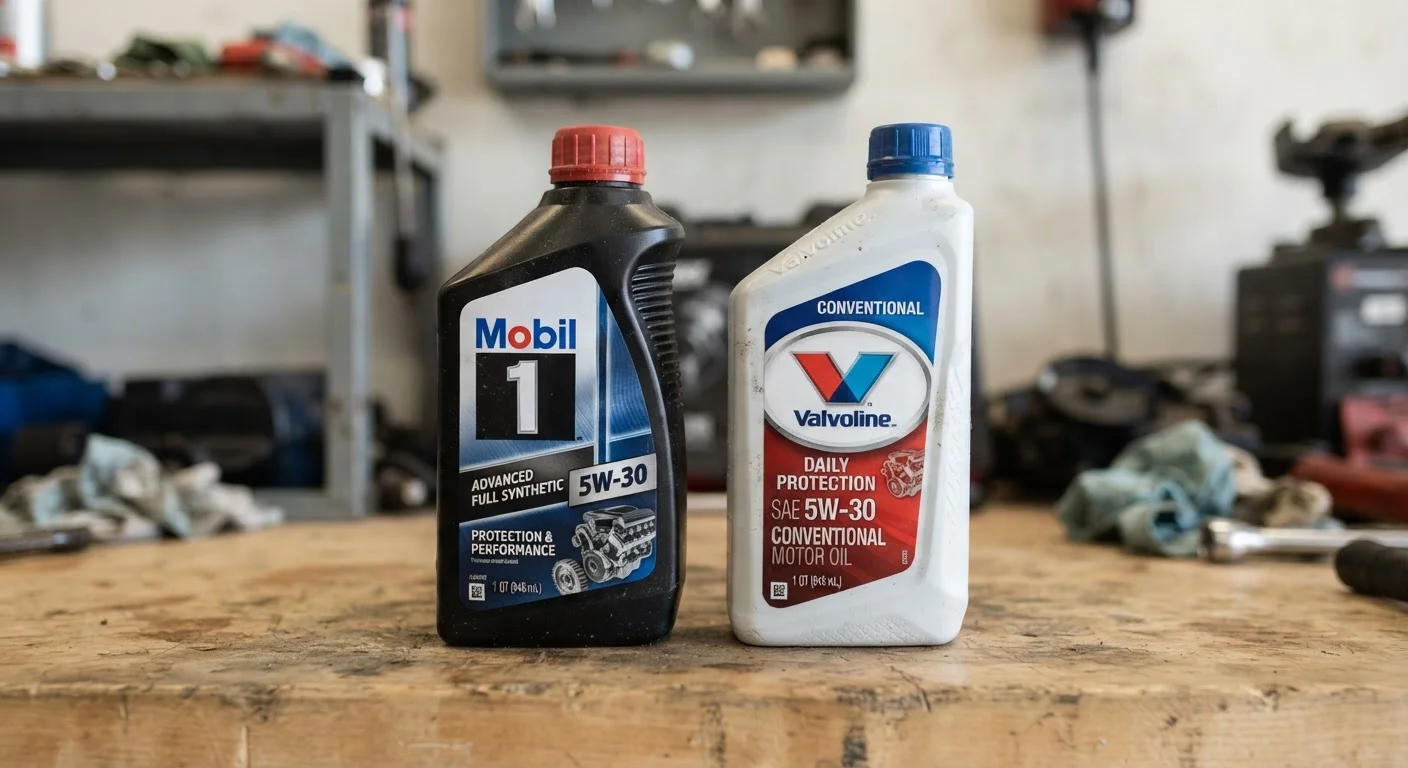
Key Takeaways
- Synthetic oil is chemically engineered; conventional oil is refined directly from crude petroleum.
- Synthetic oil generally outperforms conventional oil in extreme temperatures and high-stress driving.
- Conventional oil typically costs less per quart but requires more frequent changes.
- Always follow your vehicle manufacturer's oil specification — not just personal preference.
- Neither type is universally superior; the right choice depends on your engine, climate, and driving habits.
Option A
Synthetic Motor Oil
The engineered, high-performance choice.
Best for: Best for vehicles with demanding performance needs, extreme temperatures, longer service intervals, or turbocharged engines.
Option B
Conventional Motor Oil
The time-tested, straightforward standard.
Best for: Best for older vehicles with simple engines, light driving conditions, and owners following frequent oil change schedules.
If you drive a newer vehicle with a turbocharged or high-performance engine
Synthetic Motor Oil
Turbocharged engines run hotter and demand oil that resists breakdown under sustained heat. Synthetic oil maintains its protective film more reliably in these conditions.
If you drive an older vehicle with high mileage and no history of synthetic use
Conventional Motor Oil
Some high-mileage engines with worn seals may respond poorly to switching oil types abruptly. Consult a qualified mechanic before changing your oil type on an older vehicle.
If you live in a region with very cold winters or very hot summers
Synthetic Motor Oil
Synthetic oil flows more readily at cold start-up and resists thinning in extreme heat, providing more consistent protection across temperature extremes.
If you drive moderate miles under normal conditions and want lower upfront cost
Conventional Motor Oil
For light-duty, moderate-temperature driving with regular maintenance, conventional oil performs adequately and costs less per oil change.
How Each Oil Is Made
The most fundamental difference between synthetic and conventional motor oil is their origin and manufacturing process.
Conventional motor oil — sometimes called mineral oil — is refined from crude petroleum extracted from the ground. During refining, impurities are removed, but the resulting oil still contains a mix of hydrocarbon molecules of varying sizes and shapes. That molecular inconsistency is important: it affects how the oil behaves under stress.
Synthetic motor oil is built rather than refined. Chemists start with a base stock — often derived from petroleum or natural gas — and then precisely engineer the molecular structure to produce uniform, purpose-designed molecules. The result is an oil with more predictable, consistent properties. Additives are then blended into both oil types to enhance performance characteristics such as oxidation resistance, anti-wear protection, and viscosity stability.
A middle category, synthetic blend oil, mixes both base stocks. It offers some benefits of synthetic at a lower price point, and is worth understanding if you're exploring options. For a broader look at oil grades and what the numbers on the label mean, see our guide to viscosity grades and change intervals.
Performance in Real-World Conditions
Understanding how each oil type behaves in your engine — not just in a lab — is where the practical differences become clear.
| Criterion | Synthetic Oil | Conventional Oil |
|---|---|---|
| Base material | Engineered molecules | Refined crude petroleum |
| Cold-weather flow | Flows readily at low temps | Thickens more in cold |
| Heat resistance | High — resists breakdown | Moderate — degrades faster |
| Typical change interval | 7,500–15,000 miles | 3,000–5,000 miles |
| Cost per quart | Higher | Lower |
| Suited to turbocharged engines | Yes — commonly specified | Generally not recommended |
| Molecular consistency | Uniform, purpose-designed | Variable mix of molecule sizes |
Cold starts are one of the most stressful moments for any engine. Oil must flow immediately to lubricate moving parts before heat builds. Conventional oil thickens more at low temperatures, meaning it takes slightly longer to circulate fully. Synthetic oil flows more readily in the cold, reducing that brief but real period of metal-on-metal contact.
Heat resistance is equally important. Under sustained heat — especially in turbocharged engines or stop-and-go city traffic — oil can oxidize and break down, losing its ability to lubricate effectively. The uniform molecular structure of synthetic oil makes it more resistant to this degradation.
Change intervals differ significantly. Conventional oil is typically changed every 3,000–5,000 miles under normal conditions, while many synthetic oils are formulated for intervals of 7,500–15,000 miles. However, always defer to your vehicle owner's manual over any general guideline — manufacturers specify the interval for your particular engine.
~44%
Engine wear occurs at cold start-up
Industry estimates suggest a significant share of engine wear happens in the first moments after starting, before oil fully circulates — a key argument for fast-flowing synthetic oil.
2x–3x
Longer typical change interval for synthetic
Synthetic oil is commonly formulated to last two to three times longer between changes than conventional oil, though actual intervals depend on the vehicle and driving conditions.
Which Oil Does Your Vehicle Actually Need?
The most reliable answer to this question is not in a comparison article — it's in your vehicle's owner's manual. Manufacturers specify an oil type and viscosity grade based on the engine's design, tolerances, and expected operating conditions. Using a different type than specified may not cause immediate damage, but it can affect warranty coverage and long-term engine health.
That said, several factors commonly point toward one oil over the other:
- Engine age and design: Many modern engines — particularly those with variable valve timing or turbochargers — are engineered with synthetic oil in mind. Older, simpler engines may have no specific requirement.
- Climate: Drivers in climates with temperature extremes in either direction often benefit from synthetic oil's wider operating range.
- Driving patterns: Frequent short trips, towing, or driving in dusty conditions put more stress on oil and may warrant the added protection of synthetic.
- Cost consideration: Synthetic costs more per quart but is typically changed less often, so the total annual cost difference may be smaller than it first appears.
If you're unsure whether your current oil type is appropriate, a qualified mechanic can inspect your engine and review your driving habits to give informed guidance. For context on how engine oil fits into broader vehicle care, our engine oil explainer covers grades and change intervals in depth.
This article is for general informational purposes only. Always consult your vehicle owner's manual and a qualified mechanic before making changes to your vehicle's maintenance routine.