

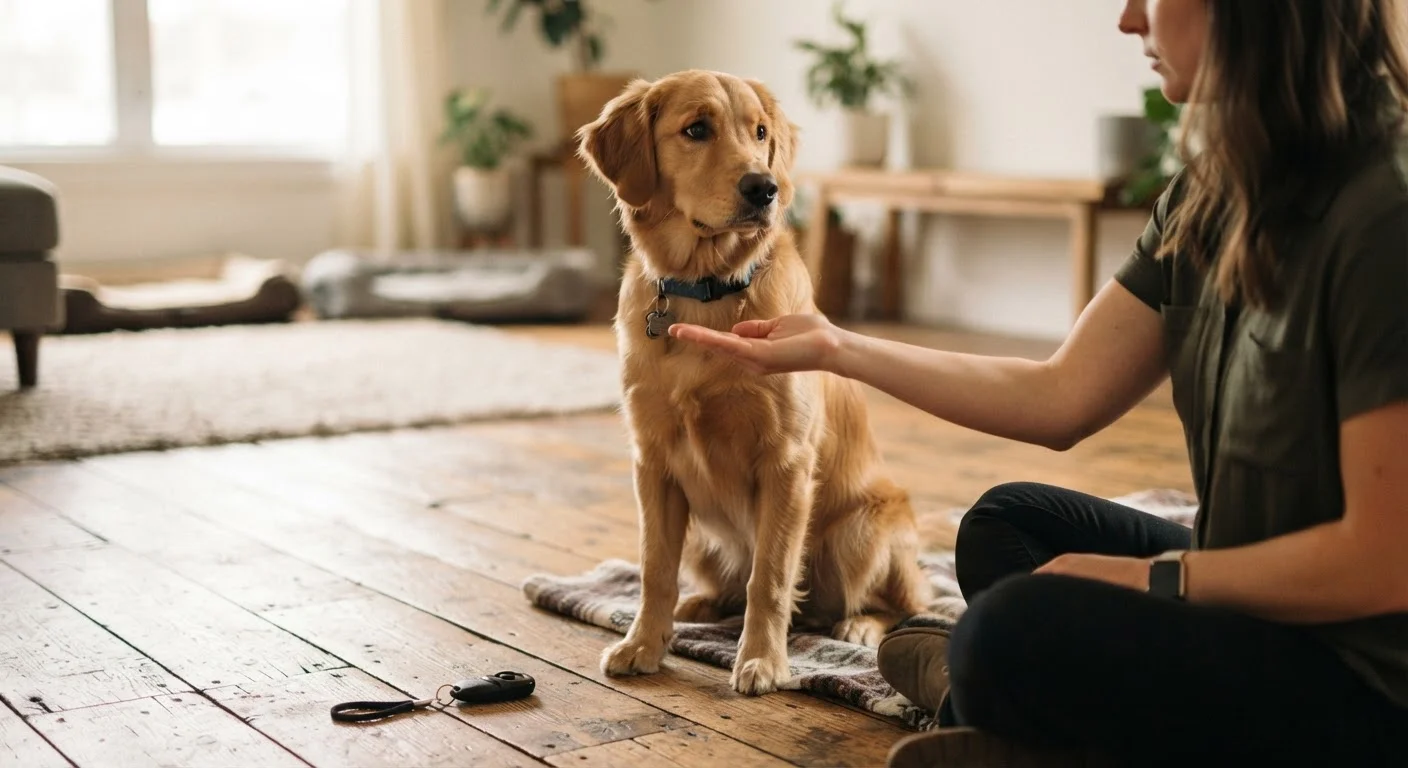
Key Takeaways
- Both methods rely on the same operant conditioning principle: a marker signals that a reward is coming.
- Clickers produce a more acoustically consistent signal, which can accelerate the early stages of learning.
- Verbal markers are always available and function well in social settings where carrying a device is impractical.
- The best marker is the one used consistently and always paired promptly with a reward.
- Many trainers use both methods depending on context, environment, and the animal's individual learning style.
Option A
Clicker Training
The precision tool favored by professional trainers.
Best for: Owners who want a highly consistent, acoustically distinct marker and are training in structured, predictable environments.
Option B
Verbal Marking
The always-available, hands-free alternative.
Best for: Owners seeking a flexible, convenient marker that requires no extra equipment and works across varied everyday situations.
If you want maximum precision during formal skill-building sessions
Clicker Training
The clicker's sharp, uniform sound reduces ambiguity, helping animals isolate exactly which behavior earned the reward — particularly valuable when teaching complex or subtle behaviors.
If you need a marker that's always available in daily life
Verbal Marking
Your voice is always with you, making verbal marks easy to use during walks, public outings, or spontaneous training moments when a clicker isn't in hand.
If you're training a pet with hearing impairment
Verbal Marking
For hearing-impaired animals, neither standard method applies — consult a certified trainer about visual or tactile markers instead.
If you're working with multiple animals or in a group class
Clicker Training
A clicker's distinct sound is easier for an individual animal to associate with its own correct response, reducing confusion in noisy multi-animal settings.
The Shared Foundation: What Marker Training Actually Does
Whether you click or say "yes," the underlying mechanism is identical. Marker training — sometimes called event marking — uses a brief, consistent signal to communicate to an animal the precise moment a desired behavior occurred. That signal is then followed by a reward, typically a food treat. Through repetition, the marker itself gains meaning as a predictor of good things, a process called conditioned reinforcement.
This approach is grounded in decades of behavioral science research. The core idea is that the faster and more precisely you can communicate "that's the one" to your pet, the clearer the feedback loop. Both clickers and verbal markers accomplish this goal — what separates them is how they do it and where each has practical advantages.
| Criterion | Clicker Training | Verbal Marking |
|---|---|---|
| Signal consistency | Very high — identical every time | Variable — affected by mood and tone |
| Equipment required | Yes — clicker device needed | None — voice always available |
| Hands-free use | No — one hand occupied | Yes — fully hands-free |
| Best training stage | Early shaping and precision skills | Daily life reinforcement and maintenance |
| Multi-animal environments | Easier to individualize per animal | Can cause confusion if words are similar |
| Learning curve for owner | Moderate — timing and device management | Low — but tone control takes practice |
Where Clicker Training Excels
The clicker's primary strength is acoustic consistency. Every press produces an identical sound at roughly the same volume, pitch, and duration. This uniformity matters because animals learning through association are sensitive to variation — a tired, frustrated, or excited voice sounds different even when saying the same word. The clicker removes that emotional noise from the signal.
Professional trainers frequently rely on clickers when teaching behaviors that require fine timing, such as precise positions in dog agility or shaping complex trick behaviors step by step. Research in animal behavior supports the idea that a highly distinct, non-contextual sound creates a stronger and faster conditioned response in early training stages.
The tradeoff is logistical: you need a hand free to operate the device, and you must have it with you. Forgetting your clicker at home means falling back on another method mid-session, which can introduce inconsistency.
Where Verbal Marking Shines
A verbal marker — commonly a short word like "yes" spoken in a consistent, upbeat tone — trades some acoustic precision for enormous convenience. Your voice is always available. This makes verbal marking especially practical for spontaneous training opportunities: catching a dog offering polite behavior at the door, reinforcing a cat stepping onto a target mat, or rewarding a parrot for calmly stepping onto a hand.
Verbal markers also allow for hands-free operation, which matters in environments where holding a device is awkward or unsafe. They're also easier for multiple household members to use without extra equipment, which can support consistency across the whole family.
The key challenge is keeping your tone genuinely consistent. Because human voices naturally shift with mood, trainers using verbal marks benefit from practicing a crisp, neutral delivery so the marker doesn't become emotionally loaded or variable in ways the animal must decode.
A Note on Marker Words and Pets Other Than Dogs
Verbal marking works across species — it has been used successfully with cats, horses, birds, and small mammals. The key is selecting a marker word that isn't part of everyday conversation, so the signal remains distinct and the animal doesn't become desensitized to it. Short, punchy words spoken in a consistent register tend to work best across species.
How to Choose — and How to Switch
There's no universally superior method. The right marker is the one you'll use correctly and consistently. If you're just starting out, pick one and condition it properly: pair the signal with a high-value reward dozens of times before asking your pet to do anything for it. This "loading" phase builds the association that makes the marker meaningful.
Many experienced trainers use both: a clicker during structured skill-building sessions and a verbal marker throughout the day. Switching between them is generally fine as long as each has been individually conditioned and is used consistently within a given session. If you decide to transition from one to the other, simply repeat the loading process with the new marker — most animals pick it up quickly.
Regardless of method, timing remains the most critical variable. A marker delivered even one to two seconds after the behavior can mark the wrong thing. Focus on that first, and the choice of signal becomes secondary.