

Key Takeaways
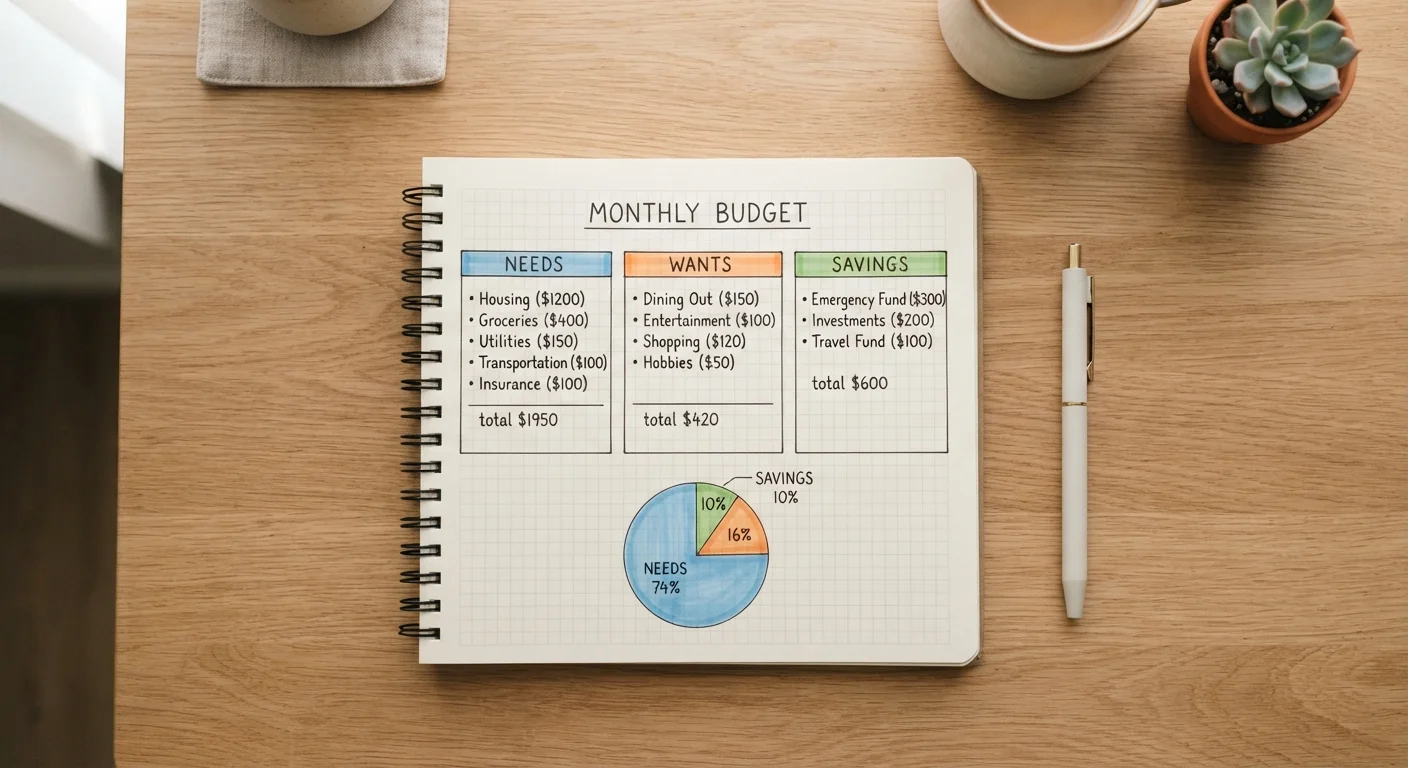
- The rule splits after-tax income into 50% needs, 30% wants, and 20% savings or debt repayment.
- It requires no complex spreadsheets — just three spending buckets and consistent tracking.
- Needs are expenses you cannot reasonably avoid; wants are discretionary choices.
- The 20% category can cover an emergency fund, retirement contributions, or extra debt payments.
- The percentages are guidelines, not rigid rules — adjust them to fit your income and cost of living.
- High housing costs or irregular income may require you to modify the standard split.
The 50/30/20 Rule
The 50/30/20 rule is a budgeting framework that divides your after-tax income into three categories: 50% for needs, 30% for wants, and 20% for savings and debt repayment. It gives you a simple, percentage-based structure to follow without requiring a detailed line-item budget. The goal is to strike a sustainable balance between covering essentials, enjoying your life, and building financial security.
The framework was popularized by Senator Elizabeth Warren and her daughter Amelia Warren Tyagi in their 2005 book 'All Your Worth.' It applies to net (after-tax) income, not gross income.
How the Three Categories Work
The 50/30/20 rule operates on a single starting point: your monthly after-tax income. From that figure, you allocate funds across three buckets.
50% — Needs
Needs are non-negotiable expenses. These include rent or mortgage payments, utility bills, groceries, health insurance premiums, minimum loan payments, and basic transportation costs. If going without it would create a serious hardship, it belongs here. Be honest with this category — a premium cable package is not a need, even if it feels routine.
30% — Wants
Wants cover everything discretionary: dining out, entertainment, travel, clothing beyond the basics, and subscription services. This bucket is not a reward — it is a planned allocation that prevents lifestyle spending from quietly eroding your finances. Treating wants as a legitimate category reduces guilt and makes the budget more sustainable.
20% — Savings and Debt Repayment
The final 20% builds your financial future. This includes contributions to an emergency fund, retirement accounts such as a 401(k) or IRA, and any debt payments above the required minimum. If you are just starting out, building an emergency fund is a sensible first priority within this bucket before directing funds elsewhere.
Start With a Single Month of Actual Spending
Before adjusting your habits, pull one month of bank and credit card statements and tag every expense as a need, want, or savings contribution. This baseline reveals where your money actually goes versus where you think it goes. Most people are surprised by how much accumulates in the wants category through small, frequent purchases.
Putting the Numbers Into Practice
Applying the framework starts with one calculation. Suppose your take-home pay is $3,600 per month. The breakdown looks like this:
| Category | Percentage | Monthly Amount |
|---|---|---|
| Needs | 50% | $1,800 |
| Wants | 30% | $1,080 |
| Savings & Debt | 20% | $720 |
Once you have your three target numbers, compare them against your actual spending from the past one to two months. Most people discover their wants bucket is the largest source of overspending — not their needs. If you have never tracked your spending before, the introduction to personal budgeting walks through how to categorize your expenses from scratch.
60%
Americans living paycheck to paycheck
A 2023 LendingClub report found approximately 60% of U.S. adults reported living paycheck to paycheck, underscoring how widely a structured savings habit is lacking.
20%
Recommended savings and debt repayment rate
The 20% savings target aligns with general guidance from financial educators and consumer protection organizations for building long-term financial stability.
$1,000
Median emergency savings among low-income households
Research from the Urban Institute has found that many households lack sufficient liquid savings to absorb even modest unexpected expenses, highlighting the importance of the savings bucket.
When the Standard Split Does Not Fit
The 50/30/20 rule was designed as a starting point, not a universal prescription. Several common situations call for adjusting the percentages.
High Cost-of-Living Areas
In cities where average rent consumes 35–40% of a moderate income on its own, the 50% needs cap becomes unrealistic. In this case, compress the wants category first, and acknowledge that your savings percentage may need to grow incrementally rather than immediately hitting 20%.
Irregular or Variable Income
Freelancers, gig workers, and commission-based earners face fluctuating monthly income. A practical adaptation is to calculate your average monthly net income over the past six to twelve months and apply the percentages to that figure, then build a buffer in lean months. Couples managing shared finances may also find that the joint budget conversation benefits from agreeing on which income figure to use.
Aggressive Debt Payoff Goals
If high-interest debt is your primary financial concern, temporarily increasing the 20% allocation — by pulling from the wants category — is a reasonable adaptation. Once debt is eliminated, redirecting those funds to savings restores the balance. After any major life event or financial shift, a monthly budget review helps you catch when your allocations have drifted from your goals.
The Rule Works Best as a Habit, Not a One-Time Exercise
Many people calculate their 50/30/20 split once and then lose track. The framework delivers the most value when you review your three totals at the end of each month and compare them to your targets. Even a five-minute monthly check is enough to catch drift before it becomes a problem. Consistent awareness, not perfection, is the goal.
Strengths and Limitations of the Rule
The 50/30/20 framework succeeds because of its simplicity. It requires no specialized software, no complex spreadsheet, and no daily receipt tracking. Three numbers are easier to monitor than thirty line items, which means more people actually stick with it.
Its main limitation is precision: the broad categories can mask problem areas within a bucket. Someone might stay within the 30% wants ceiling while still making poor individual spending choices. For readers who want more granular control, zero-based budgeting offers an alternative that allocates every dollar explicitly.
Used consistently, the 50/30/20 rule is less about perfection and more about direction. Hitting 49/31/20 or 52/28/20 in a given month is not a failure — it is information. The goal is a long-term pattern where savings grow steadily and essential expenses stay manageable.
This article provides general financial education and is not personalized financial advice. Consider consulting a licensed financial professional for guidance specific to your circumstances.