

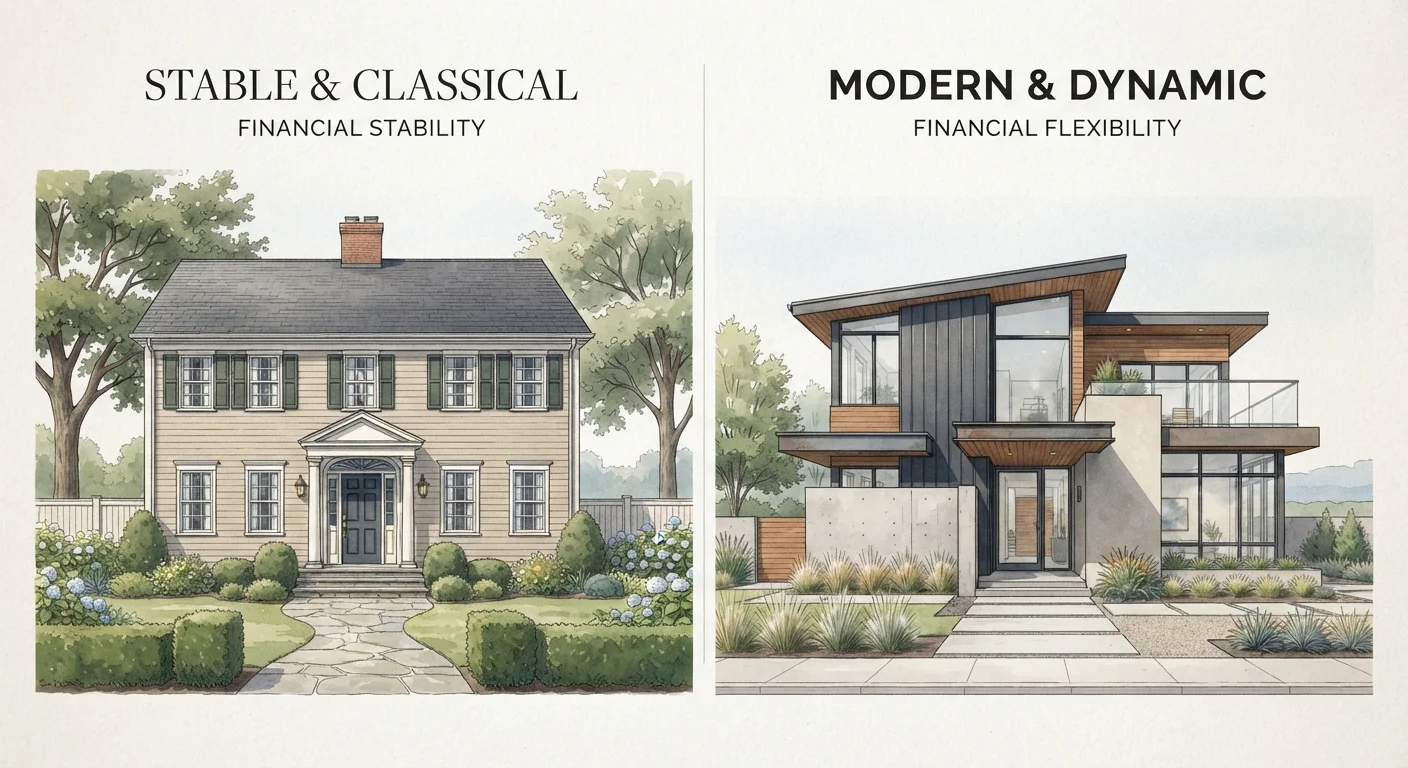
Key Takeaways
- Fixed-rate mortgages lock your interest rate for the entire loan term, ensuring payment stability.
- Adjustable-rate mortgages start with a lower rate that can rise or fall after an initial fixed period.
- ARMs carry more financial uncertainty over time due to rate adjustments tied to market indexes.
- Your expected time in the home is one of the most important factors in choosing between the two.
- Both loan types involve trade-offs — neither is universally superior for all borrowers or situations.
- Consulting a licensed mortgage professional helps align your choice with your broader financial picture.
Option A
Fixed-Rate Mortgage
The predictable, long-term stability choice.
Best for: Buyers who plan to stay in a home long-term and want consistent monthly payments regardless of market conditions.
Option B
Adjustable-Rate Mortgage (ARM)
The flexible, lower-entry-cost alternative.
Best for: Buyers who expect to move or refinance within a few years and want to take advantage of a lower initial interest rate.
If you plan to stay in your home for 10 or more years
Fixed-Rate Mortgage
Long-term owners benefit most from rate certainty, especially if rates rise significantly over the life of the loan.
If you expect to sell or refinance within 5–7 years
Adjustable-Rate Mortgage (ARM)
A lower initial rate can reduce monthly costs during your ownership window before the adjustment period begins.
If your income is stable and budgeting predictability matters most
Fixed-Rate Mortgage
Consistent payments make long-range financial planning more straightforward and reduce exposure to rate volatility.
If you're comfortable with some financial risk and market monitoring
Adjustable-Rate Mortgage (ARM)
Borrowers who understand rate caps and index movements may find an ARM cost-effective in certain interest rate environments.
How Fixed-Rate Mortgages Work
A fixed-rate mortgage is exactly what its name suggests: the interest rate is set at closing and remains unchanged for the entire loan term, typically 15 or 30 years. Your principal and interest payment stays the same from month one to the final payment, regardless of what happens to broader interest rates in the economy.
This consistency is the loan's defining advantage. Homeowners can plan budgets years in advance without worrying that a rate shift will change their housing costs. For many buyers — particularly those purchasing a long-term primary residence — that stability is worth paying a slightly higher initial rate compared to adjustable alternatives.
It's worth understanding what stays fixed and what doesn't. Your principal and interest payment is locked in, but property taxes, homeowner's insurance, and any HOA fees — often bundled into an escrow payment — can still change year to year. Understanding terms like amortization and APR helps clarify what the fixed rate actually governs.
| Criterion | Fixed-Rate Mortgage | Adjustable-Rate Mortgage (ARM) |
|---|---|---|
| Interest Rate | Locked for entire loan term | Fixed initially, then adjusts periodically |
| Initial Rate Level | Typically higher than ARM intro rate | Usually lower during introductory period |
| Payment Predictability | Fully predictable principal and interest | Variable after fixed period ends |
| Rate Risk | None — rate cannot increase | Rate can rise with market index |
| Best Ownership Horizon | Long-term (10+ years) | Shorter-term (5–7 years) |
| Common Loan Terms | 15-year or 30-year | 5/1, 7/1, or 10/1 ARM structures |
| Rate Caps | Not applicable | Periodic and lifetime caps apply |
How Adjustable-Rate Mortgages Work
An adjustable-rate mortgage (ARM) begins with a fixed introductory rate — commonly for 5, 7, or 10 years — then adjusts periodically based on a financial market index, such as the Secured Overnight Financing Rate (SOFR). The loan's name often reflects this structure: a 5/1 ARM has a five-year fixed period followed by annual adjustments.
The initial rate on an ARM is typically lower than a comparable fixed-rate loan, which reduces early monthly payments. That difference can be meaningful for buyers who don't intend to stay in the home long enough for adjustments to kick in. However, once the fixed period ends, the rate — and therefore the payment — can move up or down depending on market conditions and the loan's specific terms.
ARMs come with built-in caps that limit how much the rate can change at any single adjustment and over the life of the loan. Even so, if rates rise sharply, monthly payments can increase substantially. Borrowers considering an ARM should model what their payment would look like at the cap ceiling, not just the starting rate. This kind of forward-looking planning connects directly to how variable costs behave differently than fixed ones within a household budget.
~30 years
Most common fixed-rate mortgage term in the U.S.
The 30-year fixed-rate mortgage has been the dominant home loan structure for American borrowers for decades, according to federal housing finance data.
5/1, 7/1
Most common ARM structures offered by lenders
Industry data consistently shows these two ARM formats as the most frequently offered adjustable products at origination.
2–5 caps
Typical periodic adjustment cap on most ARMs
Most conforming ARM loans limit each rate adjustment to 2 percentage points per period, with a lifetime cap commonly ranging from 5 to 6 points above the initial rate.
Comparing the Two Side by Side
The right choice depends heavily on individual circumstances — particularly how long you plan to own the home, your risk tolerance, and where interest rates stand at the time you borrow. Neither mortgage type is inherently superior; each involves a distinct set of trade-offs.
Buyers who prioritize certainty and are purchasing what they expect to be a long-term home typically find fixed-rate loans more appropriate. Those expecting a shorter ownership window — perhaps buying a starter home before upgrading — may find the lower entry cost of an ARM genuinely advantageous, provided they understand and are prepared for potential adjustments.
It's also worth situating this decision within your larger financial picture. For example, how much cash you're allocating to a down payment versus keeping liquid, or whether you're balancing mortgage debt with other financial goals, affects how much rate variability you can absorb. Our article on managing debt versus building savings explores related thinking. And if you're still deciding whether to buy at all, the renting vs. buying trade-offs deserve equal attention.
Understanding Rate Cap Structure on ARMs
ARM rate caps are typically expressed as three numbers — for example, 2/2/5. The first number is the cap on the first adjustment, the second is the cap on subsequent adjustments, and the third is the maximum the rate can rise over the life of the loan. Always ask your lender to show you payment scenarios at each cap level before committing to an ARM product.
Once you've signed, mortgage costs are just the beginning — homeownership brings additional costs many buyers don't anticipate that compound the importance of choosing a payment structure you can sustain.
This article is for general informational and educational purposes only and does not constitute personalized financial, legal, or mortgage advice. Readers should consult a licensed mortgage professional or financial adviser before making borrowing decisions.