

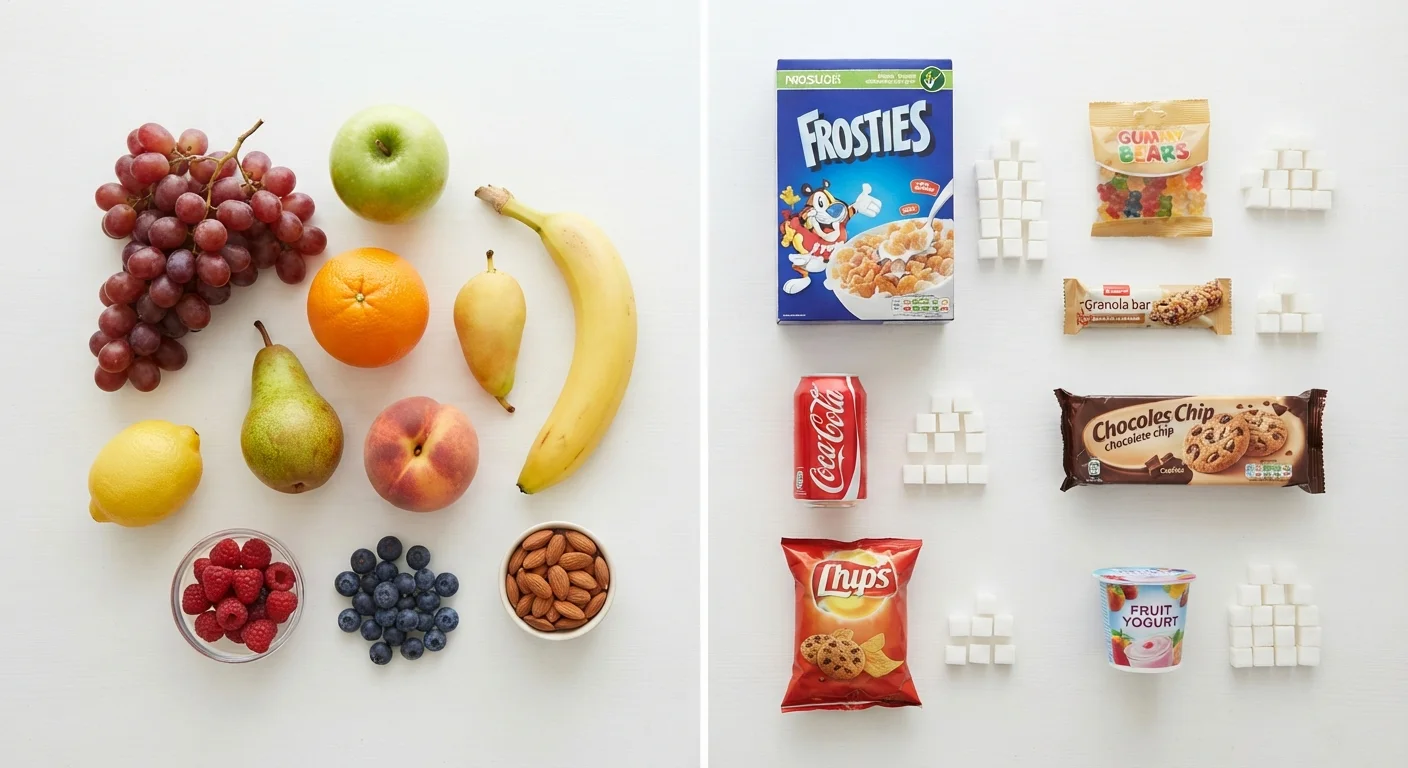
Key Takeaways
- Chemically, glucose and fructose are identical whether from fruit or a soft drink — but the food matrix changes how they behave.
- Natural sugars in whole foods arrive with fiber, water, vitamins, and minerals that slow absorption and add nutritional value.
- Added sugars provide calories with little or no accompanying nutritional benefit, a concept called 'empty calories.'
- The Dietary Guidelines for Americans recommend limiting added sugars to less than 10% of total daily calories.
- Liquid sources of added sugar are especially fast-absorbing and less satiating than whole-food sugar sources.
- Reading nutrition labels is the most reliable way to distinguish added sugars from naturally occurring ones.
Option A
Natural Sugar
Sugar delivered within a matrix of nutrients and fiber.
Best for: Everyday energy needs when consumed as part of whole, minimally processed foods like fruits, vegetables, and dairy.
Option B
Added Sugar
Sugar incorporated during food processing or preparation.
Best for: Occasional enjoyment in small amounts, but is the target for reduction in most dietary guidelines.
If you want to satisfy a sweet craving with the most nutritional upside
Natural Sugar
Whole fruits and dairy deliver sweetness alongside fiber, vitamins, and minerals, making them far more nutrient-dense choices than processed sweet foods.
If you are monitoring blood sugar or metabolic health
Natural Sugar
The fiber matrix in whole foods slows glucose absorption, generally producing a more gradual blood sugar response. Always consult a healthcare professional for personalized guidance.
If you are reading food labels to reduce overall sugar intake
Natural Sugar
Focusing cuts on added-sugar sources — sweetened beverages, desserts, and ultra-processed snacks — is where most dietary guidelines direct reduction efforts.
If you are an endurance athlete needing rapid energy during exercise
Added Sugar
In specific performance contexts, rapidly absorbed sugars can be useful for fueling sustained exercise. A sports dietitian can help tailor this appropriately.
The Chemistry: Identical Molecules, Different Packages
At the molecular level, sugar is sugar. The glucose in a banana and the glucose in a candy bar are chemically indistinguishable. Both natural and added sugars are composed primarily of glucose, fructose, or the combined molecule sucrose — and once digested into their component parts, the body processes them through the same metabolic pathways.
So if the molecules are the same, why does the source matter? The answer lies in what surrounds those sugar molecules — what nutrition scientists call the food matrix. When you eat a whole apple, the sugars arrive bundled with dietary fiber, water, pectin, polyphenols, and a range of vitamins and minerals. That matrix slows digestion, moderates the rate of glucose entering the bloodstream, and contributes meaningfully to satiety and overall nutrition.
Added sugars, by contrast, have been extracted from their original source — sugarcane, corn, beet — and incorporated into products during manufacturing or cooking. Stripped of the surrounding matrix, they are absorbed more rapidly and deliver calories with little or no accompanying nutritional benefit. This distinction is why researchers and dietary guidelines treat the two categories differently, even though the base molecules are the same.
| Criterion | Natural Sugar | Added Sugar |
|---|---|---|
| Chemical composition | Glucose, fructose, sucrose | Glucose, fructose, sucrose (identical) |
| Food matrix | Fiber, water, vitamins, minerals present | Little or no surrounding nutrients |
| Absorption rate | Slower, moderated by fiber | Faster, especially in liquid form |
| Satiety effect | Higher — fiber and bulk promote fullness | Lower — fewer satiety signals triggered |
| Nutritional value | Contributes vitamins, antioxidants, fiber | Primarily empty calories |
| Primary dietary guideline focus | Encouraged in whole-food form | Recommended to limit below 10% of calories |
| Label identification | Counted under 'Total Sugars' only | Listed separately as 'Added Sugars' on US labels |
What the Evidence Says About Health Outcomes
The bulk of research linking excessive sugar consumption to poor health outcomes — including increased risk of type 2 diabetes, cardiovascular disease, and excess weight gain — is specifically tied to added sugars, not to sugars naturally present in whole foods. Studies consistently show that high intake of sugar-sweetened beverages, the largest single source of added sugar in the American diet, is associated with adverse metabolic effects.
Whole fruit consumption, on the other hand, is generally associated in population research with neutral or positive health outcomes, including reduced risk of certain chronic conditions. This does not mean fruit sugar is metabolically irrelevant in large amounts, but it underscores that context — fiber, micronutrients, satiety signals — profoundly shapes how the body responds.
17 tsp
Average daily added sugar intake for US adults
According to CDC data, American adults consume roughly 17 teaspoons of added sugar per day — nearly double the recommended limit.
~47%
Share of added sugar from beverages
Research published in nutrition surveillance studies estimates that nearly half of all added sugar consumed by Americans comes from sweetened drinks.
<10%
Recommended ceiling for added sugar calories
The 2020–2025 Dietary Guidelines for Americans recommend that added sugars account for less than 10% of total daily caloric intake.
Liquid forms of added sugar deserve particular attention. Calories consumed in beverages tend to produce weaker satiety signals than the same calories from solid food, meaning people are less likely to compensate by eating less elsewhere. This dynamic makes sweetened drinks especially easy to over-consume.
For a parallel look at how processing strips nutritional value from another staple food, see our comparison of whole and refined grains.
How to Apply This in Everyday Eating
Understanding the distinction is useful, but it becomes most valuable when applied to daily food choices. Here are evidence-grounded principles to guide that process:
- Prioritize whole food sources of sweetness. Fresh or frozen fruit, plain dairy products like yogurt and milk, and vegetables such as sweet potatoes deliver sugar within a nutrient-rich matrix.
- Use the Nutrition Facts label. Since 2020, U.S. food labels are required to list Added Sugars as a separate line item beneath total sugars, making it easier to see how much sugar was incorporated during processing.
- Watch for hidden added sugars. Ingredients like high-fructose corn syrup, dextrose, maltose, agave nectar, and fruit juice concentrate all represent added sugars, even when they sound natural.
- Reduce liquid sugar first. Cutting back on sweetened beverages — sodas, energy drinks, flavored coffees, and fruit-flavored drinks — is one of the highest-impact steps for most people.
- Consider the whole dietary pattern. An occasional sweet treat within an otherwise balanced diet is very different from chronic high intake. Total dietary pattern matters more than any single food choice.
A Note on 100% Fruit Juice
Pure, unsweetened fruit juice contains no added sugar, but it also lacks the fiber of whole fruit, which means its natural sugars are absorbed more quickly. Most guidelines suggest preferring whole fruit over juice and, when juice is consumed, limiting portions to a small serving. This is especially relevant for children and individuals managing blood sugar levels.
This article is for general informational and educational purposes only and does not constitute medical or dietary advice. If you have specific health concerns, including diabetes or metabolic conditions, please consult a qualified healthcare professional.