

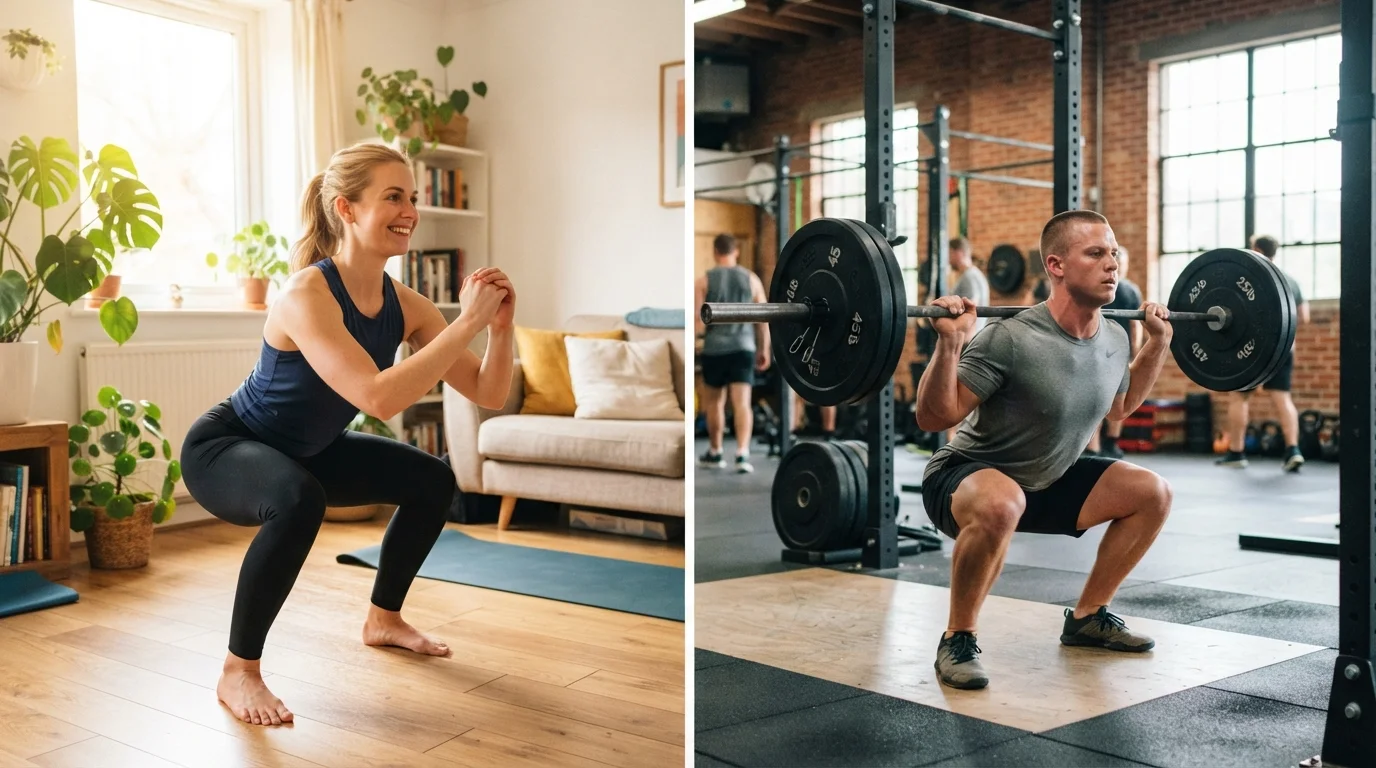
Key Takeaways
- Neither home workouts nor gym training is universally superior — both can build strength, endurance, and health.
- Equipment access, social environment, and cost are the primary practical differences between the two settings.
- The principles that drive fitness progress — progressive overload, consistency, recovery — apply equally in both environments.
- Adherence is the single most important factor; the setting you'll actually use consistently is the right one for you.
- Hybrid approaches, alternating between home and gym, work well for many people managing varied schedules.
Our Verdict
Home workouts and gym training are more alike than they are different when it comes to the fundamentals of physical progress. Equipment variety and structured environments give the gym an edge for certain training goals, while convenience and cost favor home setups. Ultimately, the setting that supports your long-term consistency will deliver the best results.
| Best for | Recommended |
|---|---|
| Those prioritizing convenience, low cost, or schedule flexibility | Home Workouts |
| Those pursuing progressive strength training or who benefit from structured social environments | Gym Training |
| People managing busy or unpredictable schedules who still want varied training | Hybrid Approach |
The Core Principles Don't Change With the Setting
Regardless of where you train, the biological mechanisms driving fitness adaptation remain the same. Progressive overload — gradually increasing the demand placed on your muscles and cardiovascular system over time — is the fundamental driver of strength and endurance gains. Whether that challenge comes from a barbell in a commercial gym or a resistance band anchored to a door, the muscular and metabolic responses are governed by the same physiology.
Consistency, adequate recovery, and sound movement patterns matter in either environment. As explored in how rest fits into any training plan, progress depends as much on recovery as on the workouts themselves — a principle that holds whether your sessions happen at home or in a facility. Similarly, common exercise myths — such as needing heavy weights to build muscle — often dissolve once you understand that stimulus, not setting, drives change.
Where the Two Settings Genuinely Differ
That said, real differences exist and are worth weighing honestly.
| Home Workouts | Gym Training | |
|---|---|---|
| Cost | Low ongoing cost; upfront equipment investment | Recurring membership fees required |
| Equipment variety | Limited without significant investment | Wide range available |
| Convenience | High — no commute or wait times | Requires travel and scheduling |
| Progressive overload potential | Achievable with creativity; harder at advanced levels | Easier to load precisely across all levels |
| Social environment | Private, low-pressure setting | Shared energy; classes and community available |
| Expert access | Self-directed; online resources available | Trainers and classes on-site |
| Core fitness principles | Identical | Identical |
Equipment range is where the gym holds a clear advantage. Access to barbells, cable machines, leg press stations, and a wide range of free weights makes it easier to load specific movement patterns with precision — particularly relevant for intermediate and advanced lifters. Home setups typically rely on bodyweight, dumbbells, kettlebells, or resistance bands, which can accommodate a broad range of training goals but may require more creativity to maintain progressive challenge over time.
Cost runs in the opposite direction. A gym membership carries a recurring monthly expense, while a home setup has upfront equipment costs but no ongoing fees. Over a multi-year horizon, home training is generally less expensive, though the gap narrows if home equipment purchases are substantial.
Social and motivational dynamics are subjective but real. Some people train harder and more consistently in a shared environment with ambient energy. Others find gyms distracting or anxiety-inducing, particularly beginners. Neither response is wrong — they simply point toward different environments being better fits for different people.
What Home Workouts Do Well
Home training excels at removing friction. No commute, no wait for equipment, no social anxiety, and no membership to justify. For people with demanding schedules, this accessibility is not a minor convenience — it is often the difference between exercising consistently and not exercising at all.
Bodyweight training, when structured thoughtfully, can develop meaningful strength, mobility, and cardiovascular fitness. Push-up progressions, single-leg squats, hip hinges, and pulling variations using a doorframe bar or suspension trainer cover the major movement patterns effectively. Pairing these with mobility and stretching work creates a well-rounded routine without any equipment at all.
Start With What Removes the Most Barriers
If a gym commute regularly becomes a reason to skip training, a home setup may support better long-term consistency — even with fewer equipment options. Conversely, if home distractions derail focus, a gym environment can serve as a dedicated mental cue for exercise. Honest self-reflection about what actually gets in the way of training is a useful starting point when deciding between the two.
Home training also integrates naturally with lower-intensity activity. A short bodyweight session in the morning or a daily walk added to routine movement can accumulate significant health benefit across a week.
What the Gym Offers That Home Setups Struggle to Match
For those pursuing specific strength benchmarks — heavier compound lifts, sport-specific conditioning, or structured periodization — a gym's equipment range is genuinely difficult to replicate at home without significant investment. Heavy barbell training, in particular, benefits from proper racks, collars, and safety equipment that are impractical for most home environments.
The gym also provides access to qualified staff, group classes, and in many cases, personal training — resources that can accelerate learning and reduce injury risk for newcomers. Adults in later decades, for instance, may benefit from the supervised environment when beginning a new program; this is discussed in more depth in the context of training considerations after 50.
For those combining strength and cardio work, a gym's dedicated cardio equipment — rowing machines, bikes, treadmills — can support structured zone 2 cardio sessions with precise intensity control. That said, integrating both modalities is entirely achievable across either environment with some planning.
Choosing What Works for Your Life
The most effective workout environment is the one you'll actually use. A hybrid approach — training at home most days and visiting a gym for heavier sessions or classes — suits many people well, combining the convenience of home with the equipment access of a facility.
Before committing to one setup, consider your primary goals, realistic schedule, budget, and honest self-assessment of what motivates consistent effort. A weekly movement routine built around real-life constraints is more sustainable — and more beneficial — than an ambitious plan that stalls within weeks.
~30%
Adults meeting aerobic activity guidelines
CDC data consistently shows only about 1 in 4 to 1 in 3 U.S. adults meet federal physical activity recommendations, underscoring that environment matters less than consistency.
6–8 weeks
Typical time to notice initial fitness adaptations
Exercise science research generally indicates that measurable strength and endurance adaptations begin within 6–8 weeks of consistent training, regardless of setting.
This article is for general informational purposes only and does not constitute medical or personal fitness advice. Consult a qualified healthcare or fitness professional before beginning any new exercise program, particularly if you have an existing health condition or injury.